
Apple Just Made Third-Party MDM a Harder Sell for Small Business
Apple Business unifies MDM, email, and brand tools in one free platform — and it's a direct challenge to third-party MDM vendors targeting the small business market.

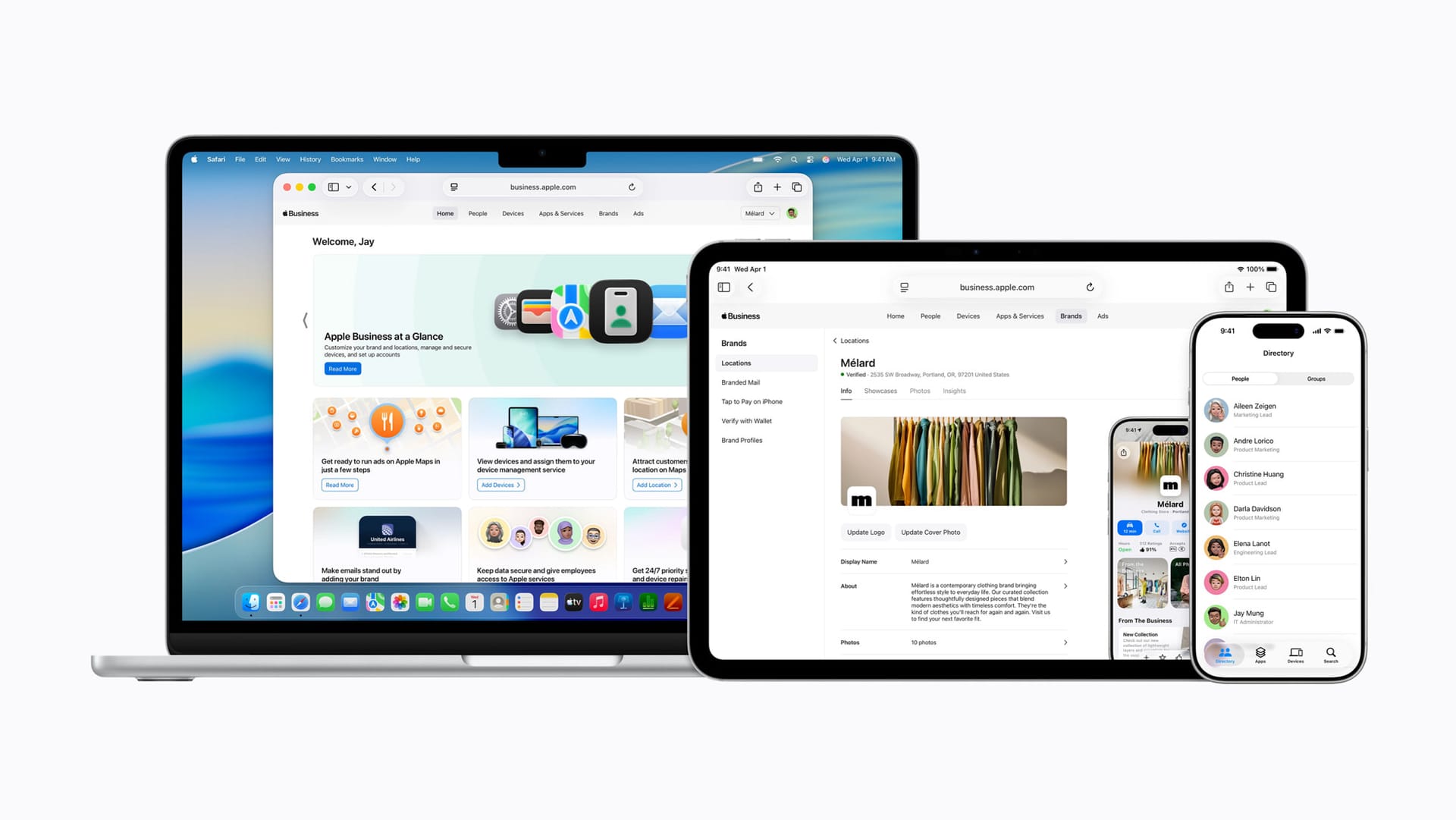
For years, small and mid-sized businesses that wanted to manage their Apple devices professionally had a problem: Apple's tools were fragmented, confusing, and expensive if you wanted the full picture. Apple Business Manager gave you device enrollment and app purchasing. Apple Business Connect let you manage your Maps listing. Apple Business Essentials added MDM, but only in the U.S., and only as a subscription that felt half-baked compared to dedicated platforms. If you wanted everything working together, you were either stitching together Apple's scattered offerings or paying a third party to do it for you.
That calculus changes on April 14.
Apple Business launches as a single, free platform that folds in device management, email and calendar with custom domain support, brand presence across Apple Maps and Wallet, and (arriving this summer) the ability to run ads directly in Maps. Three previously separate products disappear. One platform replaces them all. And for the first time, MDM isn't a paid add-on exclusive to the U.S.: it's included, globally, for free.
The MDM Market Just Got a New Competitor
To understand what Apple is actually doing here, you have to think about the businesses that were never going to buy Jamf.
Enterprise IT shops managing thousands of Apple devices have long had good options: Jamf, Mosyle, Kandji, Addigy, and a handful of others built sophisticated platforms that go well beyond what Apple ever offered natively. Those products exist because Apple left a gap, and the vendors filled it well. For an organization running 500 Macs, paying for a dedicated MDM solution is obviously worth it.
But what about the architecture firm with 12 employees, all on MacBooks? The restaurant group with 30 iPads across four locations? The marketing agency where the office manager is also the de facto IT person? These businesses needed something too, but they couldn't justify the cost and complexity of an enterprise MDM platform, and Apple's own tools weren't up to the task.
Apple Business Essentials tried to solve this. It mostly didn't. It was U.S.-only, subscription-based at a time when the value proposition wasn't obvious, and sat awkwardly alongside Apple Business Manager without quite integrating cleanly. It was a product that felt like Apple testing the water rather than committing to the pool.
Apple Business is the commitment.
The new Blueprints feature (preconfigured device settings that enforce consistency and enable zero-touch deployment) is specifically designed for "small businesses without dedicated IT resources," per Apple's own language. That's a pointed admission about who this product is for, and it's the same customer segment that third-party MDM vendors have been trying to court with simplified pricing tiers and no-IT-required onboarding for the past several years. Apple is now walking directly into that space with a free product.
More Than MDM
The platform's scope goes well beyond device management, and that's where the strategic ambition becomes clearer.
Email and calendar with custom domain support might sound like table stakes, since Google Workspace and Microsoft 365 have owned this space for years, but Apple is positioning it as the starting point for a new business. Not an IT tool bolted onto an existing operation, but the infrastructure a founder sets up on day one. Bring your domain, configure your team, enroll your devices: all from the same place. If you're already in the Apple ecosystem personally, Apple Business is betting you'll want to stay there professionally.
The brand management features, migrated from Apple Business Connect, let companies control how they appear across Maps, Wallet, Spotlight, Safari, and Mail. Tap to Pay on iPhone displays your logo on the payment screen. Tracked orders in Wallet show your branding. These aren't new capabilities, but consolidating them alongside MDM and email means a small business can, in theory, go from zero to operational Apple infrastructure in a single dashboard.
Then there's Maps advertising.
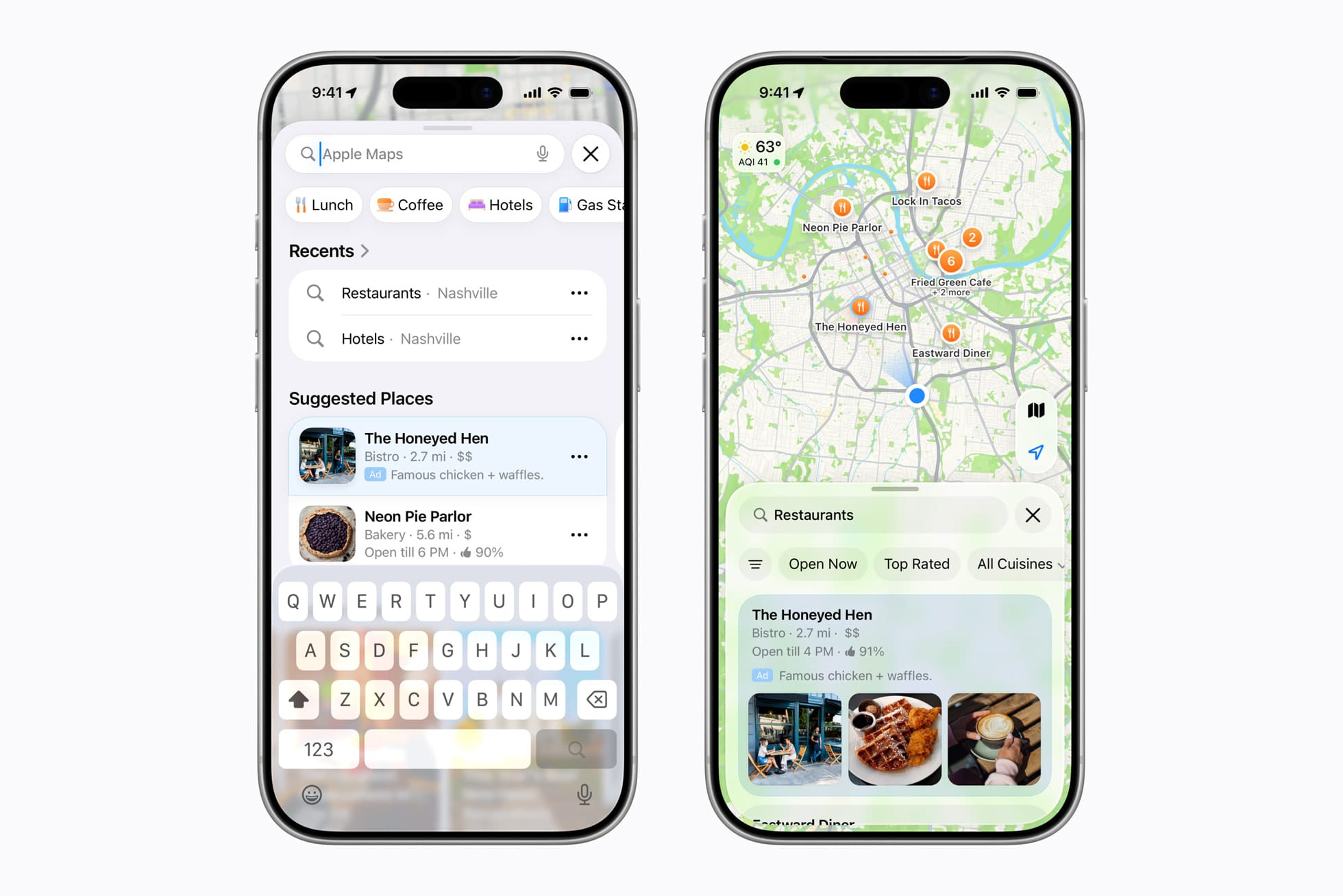
Coming this summer to the U.S. and Canada, Apple Business will let companies create ads that appear in Maps search results and a new "Suggested Places" feature that surfaces recommendations based on trending nearby activity and recent searches. Apple is careful to emphasize privacy (location data stays on-device and isn't tied to Apple Account), but the commercial intent is unmistakable. Apple is building a local business advertising platform inside its mapping product, and it's using Apple Business as the on-ramp.
This is Apple competing directly with Google's local advertising model, which has long been a meaningful revenue source for small businesses that live and die by search visibility. If Apple Maps continues to grow its user base (and it has made genuine strides in quality over the past several years), local ads in Maps become an increasingly attractive alternative to paying for Google's attention.
What This Costs (and What It Doesn't)
The base Apple Business platform is free. That's not a soft launch price or a promotional period: it's the model. Device management, email, calendar, directory, brand management, location insights, all of it. Free.
The monetization comes through add-ons: iCloud storage starting at $0.99 per user per month (up to 2TB), AppleCare+ for Business at $6.99 per device per month or $13.99 per user per month for up to three devices, and eventually paid Maps advertising.
Existing Apple Business Essentials customers stop being charged their monthly fee for device management when Apple Business launches. That's a price reduction for current subscribers, and a reasonable goodwill move ahead of a major platform consolidation.
The full feature set, including the companion app for employees and the email and calendar tools, requires iOS 26, iPadOS 26, and macOS 26, which ties the platform's utility directly to Apple's next OS cycle launching later this year.
The Real Tension
None of this puts Jamf out of business. Enterprise organizations with complex compliance requirements, nuanced security policies, and large mixed-fleet environments will still need platforms that go far deeper than what Apple is offering. The Admin API that Apple Business includes is useful, but it's not the same as the workflow automation, reporting depth, or integration ecosystem that enterprise MDM customers depend on.
What Apple Business does is compress the addressable market for those vendors at the low end. Companies that might have evaluated a simplified MDM solution can now skip that conversation entirely. The free tier is good enough to keep them in Apple's own platform, and the more businesses that run their operations through Apple Business, the more natural it becomes to buy devices through Apple, pay for AppleCare, and advertise in Maps.
Apple has always had ambitions in the enterprise and small business space. Those ambitions have historically been undercut by fragmented execution: too many separate products, too many separate dashboards, too much friction. Apple Business is the clearest attempt yet to fix that at the foundation. Whether small businesses actually adopt it in meaningful numbers, or whether the OS 26 requirement creates a slow ramp through the fall, will determine how quickly this changes the competitive landscape.
But the direction is unambiguous. Apple wants to be the operating system for small business, not just the device vendor.
Apple Business launches April 14 in more than 200 countries and regions. Ads on Maps will be available this summer in the U.S. and Canada.
Written by

Subscribe to our newsletter
Subscribe to our newsletter to get the latest Apple updates and news









Member discussion