
Apple Opens Xcode to AI Agents, Signaling a Strategic Shift in Developer Tools
Apple's Xcode 26.3 adds native support for AI coding agents including Claude and Codex, plus Model Context Protocol integration

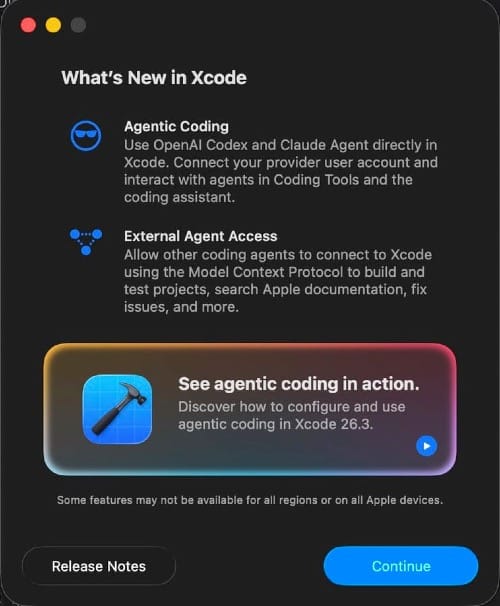
Apple's announcement of Xcode 26.3 doesn't just add another feature to its development environment—it represents a philosophical pivot in how Apple thinks about the relationship between developers and AI tools. By integrating direct support for Anthropic's Claude Agent and OpenAI's Codex, Apple is acknowledging something the broader developer community figured out months ago: agentic coding isn't a gimmick, it's the next paradigm.
The timing matters. We're past the initial AI coding assistant wave that delivered autocomplete on steroids. This is about delegating entire workflows—task decomposition, architectural decisions, documentation searches, preview captures, build verification—to systems that can reason through complex problems autonomously. Apple isn't just following the trend; they're packaging it in a way that makes sense for their ecosystem.
What Changed Under the Hood
The architecture here is worth understanding. Xcode 26 introduced AI-powered coding assistance for Swift—essentially smart suggestions and editing capabilities. Xcode 26.3 expands that foundation by exposing substantially more of Xcode's internal capabilities to external agents. These agents can now navigate file structures, modify project settings, search Apple's documentation, and critically, capture Xcode Previews to visually verify their work.
That last capability is particularly interesting. Previous generations of coding assistants operated blindly, generating code without visual feedback loops. Letting agents capture and analyze Preview renders creates a closed-loop system where the agent can iterate on UI implementations by actually seeing what it built. That's not incremental—it's qualitatively different.
The integration supports two agents out of the box: Claude Agent and Codex. Apple's positioning suggests these aren't arbitrary choices but rather selections based on "advanced reasoning" capabilities and developer adoption patterns. Both services require their respective terms of service, meaning developers need accounts with Anthropic or OpenAI to use these features.
The Model Context Protocol Play
Here's where things get strategically interesting: Apple didn't just hardcode support for two vendors and call it done. Xcode 26.3 implements the Model Context Protocol, an emerging open standard for connecting AI systems to development tools. This creates a future-proof architecture where any compatible agent—including open source or custom enterprise solutions—can integrate with Xcode using the same interface.
MCP adoption by Apple validates the protocol while simultaneously giving Apple optionality. If the AI landscape shifts, if new models emerge that outperform current offerings, or if developers want to use specialized domain-specific agents, the infrastructure exists to support that without Apple shipping updates to Xcode. It's the Unix philosophy applied to AI tooling: provide clean interfaces, let ecosystems form around them.
This also insulates Apple from direct competition between AI vendors. They're not picking winners by locking into proprietary APIs. They're providing infrastructure and letting developers choose their tools. It's politically clever and technically pragmatic.
What This Means for Apple Platform Development
The immediate effect will be velocity. Developers who've experimented with Claude Code or similar tools know the productivity multiplier is real for certain tasks—boilerplate generation, test writing, refactoring, API integration. Embedding these capabilities directly into Xcode eliminates context switching and integration overhead. The agent understands your project structure natively, has access to Apple's documentation without web searches, and can verify builds without leaving the environment.
But the longer-term implication is more subtle: this makes building for Apple platforms more accessible to developers who aren't deep Swift experts. When an agent can scaffold SwiftUI layouts, implement common design patterns, and handle the architectural decisions that typically require platform-specific knowledge, the barrier to entry drops significantly. That could expand the Apple developer ecosystem in ways traditional documentation and tutorials never could.
There's a counterargument worth considering—that this could commoditize platform-specific expertise. If agents handle the intricate details of UIKit hierarchies or SwiftUI state management, does deep platform knowledge become less valuable? Probably not entirely, but the skills that matter might shift toward higher-level product thinking and architectural decisions rather than implementation mechanics.
The Missing Pieces
What Apple didn't announce is arguably as interesting as what they did. There's no mention of on-device agent execution using Apple Silicon's neural engines. Everything appears to route through external API calls to Anthropic or OpenAI. That's pragmatic short-term but leaves the door open for future iterations that run locally, potentially offering better privacy, lower latency, and offline functionality.
Similarly, there's no indication of cost handling or token management within Xcode. Developers will presumably manage this through their direct relationships with the AI providers, which keeps Apple's hands clean but creates potential friction as usage scales. A solo developer hacking on a side project has very different economics than an enterprise team shipping production apps.
The release candidate is available now through the Apple Developer Program, with a broader App Store release coming soon. That's standard Apple beta-to-production sequencing, suggesting they're confident in the implementation but want developer feedback before general availability.
Reading the Strategic Signals
Apple's move here isn't reactive—it's calculated positioning in a rapidly evolving landscape. By embracing agentic coding now rather than waiting to perfect a proprietary solution, they're acknowledging that developer experience trumps complete vertical integration. That's a departure from historical Apple DNA, where controlling the entire stack typically takes precedence.
The collaboration with Anthropic is particularly notable given Apple's general reluctance to spotlight AI vendors. Claude's recent traction in developer workflows, especially for complex reasoning tasks, likely made this partnership inevitable once Apple committed to supporting external agents. OpenAI's inclusion balances that relationship while covering developers already invested in their ecosystem.
What remains to be seen is how Apple iterates on this foundation. Will future Xcode versions offer first-party agents powered by Apple's own models? Will the MCP implementation expand to support debugging agents, testing agents, or deployment automation? The infrastructure is there; the question is how aggressively Apple builds on it.
For now, Xcode 26.3 represents Apple doing what it does best—taking an emerging developer workflow, smoothing the rough edges, and packaging it in a way that feels inevitable. Whether that accelerates agentic coding adoption broadly or simply gives Apple developers parity with what others have been building externally will become clear over the next few months. But the direction is unmistakable: AI isn't augmenting development workflows anymore. It's becoming the workflow.
Xcode 26.3 is available as a release candidate through the Apple Developer Program, with an App Store release coming soon. Agents require separate accounts with Anthropic or OpenAI.
Written by

Subscribe to our newsletter
Subscribe to our newsletter to get the latest Apple updates and news








Member discussion