
Microsoft Finally Admits Windows 11 Went Off the Rails. Now Comes the Hard Part.
Microsoft's March 2026 Windows quality commitment is the most direct admission yet that Windows 11 went off track. Here's what it means, what it promises, and why IT teams are right to wait and see.

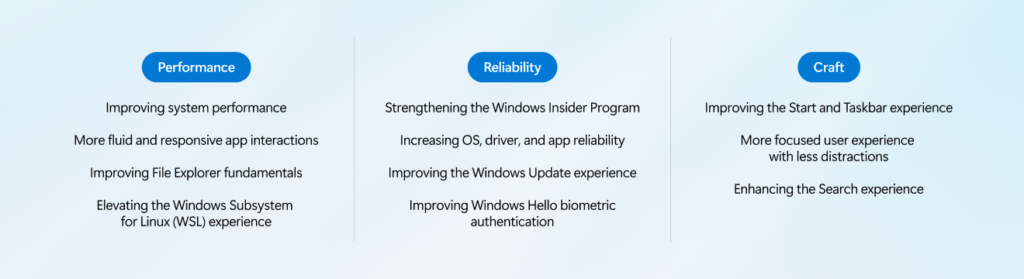
The blog post published on March 20, 2026, from Pavan Davuluri, Microsoft's EVP of Windows and Devices, reads almost like a confession. It doesn't use the word "sorry." It never says "we got this wrong." But between every carefully worded paragraph about performance pillars and reliability frameworks is an unmistakable acknowledgment: Windows 11, in its current state, is not the product Microsoft should have shipped to more than a billion users.
Davuluri opens by writing that his team spent "a great deal of time analyzing your feedback" and that what came through was "the voice of people who care deeply about Windows and want it to be better." That's a diplomatically constructed sentence. What it actually means, when you read it against the backdrop of 2025's disaster-filled update record, the "agentic OS" meltdown, the Copilot-in-everything backlash, and the spectacle of Windows 11's market share briefly reversing course and losing ground to an end-of-life operating system, is that Microsoft finally looked at what it had built and couldn't pretend anymore.
The question worth asking isn't whether these promises are real. They probably are, at some level. The question is whether Microsoft can execute them at the speed and scale Windows requires, and whether this moment represents a genuine philosophical reset or simply the latest in a recurring pattern of acknowledgment followed by drift.
How Windows 11 Got Here
To understand why this announcement matters, you have to understand how comprehensively Microsoft misjudged Windows over the past several years.
When Windows 11 launched in October 2021, the complaints were immediate but focused: aggressive hardware requirements that locked out millions of capable machines, a redesigned Start menu that users found disorienting, a taskbar stripped of features that had existed since Windows 7. Microsoft's response, for years, was essentially to hold the line. The taskbar couldn't be moved. The features weren't coming back. The direction was set.
What changed the calculus wasn't a single catastrophic decision. It was accumulation. Through 2024 and into 2025, Microsoft began layering Copilot across the OS with a kind of compulsive thoroughness. Notepad got an AI button. Photos got one. The Snipping Tool got one. The taskbar got a dedicated Copilot icon that couldn't be removed by default. Settings pages filled with gentle nudges toward Microsoft 365 subscriptions. The Start menu's Recommended section began surfacing third-party app promotions alongside actual recently used files. By late 2025, guides to disabling Windows 11's built-in advertising required users to navigate through settings menus in at least six different locations just to get the OS to stop pitching things at them.
The update quality problem ran parallel to all of this. Windows Latest documented more than 20 significant update failures across 2025 alone, including broken audio for USB DAC users in January, webcam detection failures in April, gaming performance drops of up to 50 percent in October tied to a security patch, and boot loop scenarios in December that cascaded into January 2026 because the initial failed update left machines in what Microsoft itself called an "improper state." The Start Menu, Taskbar, File Explorer, and System Settings all broke simultaneously in July 2025 due to a faulty cumulative update affecting XAML components, and Microsoft didn't officially acknowledge the issue until November, four months later.
The "agentic OS" moment in November 2025 crystallized everything. When Davuluri posted on X that Windows was "evolving into an agentic OS," the reply ratio was so lopsided that he eventually disabled comments. Out of 484 replies logged before the closure, not a single one was supportive. The post drew 247 likes to 484 comments. The top reply was simply: "Stop this nonsense. No one wants this." Developer and newsletter author Gergely Orosz used the moment to publicly declare that Windows was no longer the OS of choice for software engineers. Microsoft's Windows lead was getting ratio'd on his own announcement post while his OS was actively breaking user machines with monthly patches.
The Commitment and What It Actually Means
The March 2026 post from Davuluri outlines three pillars: performance, reliability, and craft. Reading through each section carefully, a few things stand out as genuinely significant rather than corporate boilerplate.
On performance, Microsoft is committing to reducing Windows' own memory footprint to free up more capacity for actual user applications. The announcement also mentions moving more core Windows experiences to the WinUI3 framework to reduce interaction latency, with File Explorer cited as a specific early target. For anyone who has spent years watching File Explorer inexplicably chew through memory or freeze mid-navigation, this isn't a trivial promise. It's the kind of foundational infrastructure work that either quietly fixes something users have complained about for years, or quietly fails to ship.
On reliability, the most significant enterprise-facing promise is the commitment to a single monthly reboot for updates, with genuine user control over timing. The current update behavior, which can push restarts with limited notice during workday hours, has been a persistent operational problem for IT departments managing large fleets. The announcement also specifically calls out Bluetooth connectivity failures, USB crashes, printer discoverability problems, and camera reliability issues. These aren't glamorous features, but they're the kind of daily friction points that erode confidence in a platform faster than any high-profile bug.
The Copilot pullback is the most public-facing element of the announcement, and it's worth being specific about what's actually changing versus what's being reframed. Microsoft is removing Copilot entry points from Snipping Tool, Photos, Widgets, and Notepad. It is not removing Copilot from Windows. The language Davuluri uses is carefully calibrated: the company will be "more intentional about how and where Copilot integrates," focusing on experiences that are "genuinely useful and well-crafted." The implication, which The Register pointed out bluntly, is that the prior Copilot integrations were neither intentional nor well-crafted. That's a remarkable thing for Microsoft to say between the lines about its own flagship AI strategy.
The taskbar mobility restoration deserves its own note. Repositioning the taskbar was a basic Windows feature for more than 25 years before Microsoft removed it with Windows 11. Its return, announced here as if it were new innovation, is a reminder of how far the OS drifted from the expectations of its own users.
The Enterprise IT Perspective
From an IT administration standpoint, this announcement lands differently than it does for consumers.
The Windows 11 update reliability crisis of 2025 wasn't just annoying for home users. It was operationally disruptive for IT teams managing thousands of endpoints. The Patch Tuesday model depends on a certain predictability. When a January patch breaks systems that couldn't cleanly install the December patch, and Microsoft acknowledges in its own support documentation that the partial resolution "will not prevent devices from getting into the improper state in the first place," the implicit message to IT is: you need to delay deployment and validate before rolling broadly. That's exactly what most enterprise IT organizations do, but it adds testing overhead to a cycle that was supposed to be reliable by design.
The move toward a single monthly reboot for updates, if it materializes as described, would be a meaningful concession to the operational reality of enterprise deployments. So would the expanded ability to pause updates "for as long as you need." Right now, consumer and business users alike have experienced update prompts that feel less like a maintenance schedule and more like an adversarial negotiation between the user and the operating system.
The WSL (Windows Subsystem for Linux) improvements listed in the announcement, including faster file performance between Linux and Windows environments, better enterprise policy control, and improved network compatibility, signal that Microsoft is at least paying attention to the developer migration conversation. The Gergely Orosz critique in November resonated precisely because it reflected something measurable: developers who build on Windows are increasingly testing and sometimes deploying on macOS or Linux because the day-to-day experience is more predictable. If Microsoft loses ground in developer workflow preference, it loses a constituency that influences technology choices across entire organizations.
The Cortana Pattern and Why Skepticism Is Warranted
The Register noted this directly, and it's worth repeating: Microsoft has been here before.
Cortana launched in 2014 as the AI assistant that was going to transform how people used Windows. It was embedded, prominent, and not particularly optional. By 2023, it was effectively discontinued on Windows. The parallels to the current Copilot situation are uncomfortable. An AI assistant embedded everywhere. A user base that found it intrusive. A gradual retreat after the damage to trust was already done.
The difference Microsoft is betting on is that Copilot is actually useful when applied selectively. Microsoft 365 Copilot, the $30-per-month enterprise subscription, has shown real adoption because it addresses genuine productivity workflows: summarizing email threads, drafting documents, analyzing spreadsheets. The consumer Windows version became a liability not because the underlying technology was poor, but because Microsoft deployed it like a land grab rather than a product decision.
The deeper problem is the pace at which Microsoft can actually deliver on what Davuluri promised. The Register framed this precisely: Windows development is now like a supertanker. The changes promised in this post will unfold across the remainder of 2026. The first wave of preview builds is expected in March and April. But given that almost every Windows update in 2025 introduced at least one regression, users and IT administrators have developed a reasonable habit of waiting. Waiting for the fixes to the fixes. Waiting to see whether the promised single monthly reboot actually ships. Waiting to see whether the quieter Start menu experience actually means fewer prompts or just differently located ones.
That skepticism is not cynicism. It's a learned behavior from years of Microsoft announcing that it had heard users' concerns, and then shipping something that felt indistinguishable from what came before.
What Needs to Happen for This to Mean Anything
The Davuluri post, taken on its own terms, describes the right priorities. Performance matters more than new features. Reliability is the precondition for everything else. AI should earn its place in the OS, not occupy it by default. Fewer restarts, more user control, a less cluttered experience. These are not controversial positions. They are simply what Windows used to be before Microsoft started treating it as a vehicle for AI demonstrations and service upsells.
What turns this from an apology letter into an actual course correction is execution. Specifically: does the July 2026 Patch Tuesday break something significant, or does it not? Do the File Explorer latency improvements actually ship with measurable numbers attached? Does the "reduced Copilot entry points" commitment hold through the end of the year, or does the next Copilot+ PC launch come with a new wave of OS-level integration that quietly reverses what was promised here?
For users who have spent the past two years building workarounds, the bar is lower than it might seem. They don't need Windows to be a leap forward. They need it to stop being a source of unpleasant surprises. Microsoft's Windows 11 doesn't have a feature problem right now. It has a trust problem, and trust gets rebuilt one reliable Patch Tuesday at a time.
Davuluri's post ends by inviting continued feedback "to help shape the future of Windows together." That's a reasonable sentiment. But the future of Windows is going to be shaped a lot more by what ships in the next six months than by anything said in a blog post in March.
Written by

Subscribe to our newsletter
Subscribe to our newsletter to get the latest Apple updates and news






Member discussion