

On the morning of January 1, 2023, somewhere in the world, a person opened their phone to check the weather. Maybe they were planning a hike. Maybe they were watching a storm roll in. They tapped the icon they'd tapped thousands of times — the familiar Dark Sky lightning bolt — and for the first time, nothing came back. The app was still there on the home screen. But it was dead. Apple had turned it off at midnight, with the quiet efficiency of a landlord changing the locks.
That moment is what Apple's app acquisition story actually looks like from the user side. Not the press release. Not the careful language about "continuity" and "no material changes at this time." The app you paid for, the one you built your routines around, silently gone on a holiday morning because a corporate integration schedule said it was time.
Apple acquires roughly 20 to 25 companies per year by Tim Cook's own count, though you'd only know a fraction of them from public records. The company has quietly built an acquisition playbook that most users never think about — until the app they rely on disappears. Understanding that playbook is now more relevant than ever, with Pixelmator's trajectory coming into clearer focus and the Dark Sky team's dramatic return to independence making it impossible to ignore what happens on the other side of an Apple deal.
Apple's App Acquisition Playbook: Three Outcomes, One Common Thread
The formula, loosely assembled from a decade of examples, goes something like this: identify a beloved third-party app that fills a gap in Apple's platform, acquire the team and technology, absorb the talent into Cupertino, improve Apple's own built-in experience, and quietly retire the original product. Sometimes users get a refund. Sometimes they get a press release. Sometimes they just get a sunset notification and a redirect to whatever Apple built with the pieces.
Apple's defenders always point to the success cases, and those are real. Logic Pro and Final Cut Pro are the gold standard — Apple acquired Emagic in 2002 and has genuinely stewarded Logic into one of the most powerful DAWs available at any price. Shazam still exists on Android, still works, and its song-recognition technology is now built into Siri as a bonus. Workflow became Shortcuts with dramatically more capability than the independent app ever had. These are the cases where acquisition worked for users, not just for Apple.
But they're not the whole story. Not even close.
What Happened to Dark Sky: Apple's Most Controversial App Acquisition
When Apple acquired Dark Sky in March 2020, the announcement hit the app's community like a gut punch. Dark Sky wasn't just a weather app — it was the weather app. Its hyperlocal, minute-by-minute precipitation forecasting was genuinely better than anything Apple's built-in Weather app offered, and it had built a fiercely loyal following on both iOS and Android as a result.
Within days of the acquisition closing, Dark Sky was gone from Android. Not deprecated with a transition period — gone. Android users who had paid for the app suddenly found themselves locked out of something they'd relied on with no real replacement. It was the first signal of how Apple intended to use the acquisition: as a competitive weapon, not just a talent pipeline.
Dark Sky on iOS lasted two more years, kept alive just long enough for Apple to rebuild its Weather app around the acquired technology. In January 2023, the app shut down entirely. The replacement Apple shipped was better than what it had before — credit where it's due. But it was not better than what Dark Sky had been. Years of consistent user complaints about accuracy, delayed severe weather alerts, and forecasts that don't match conditions outside the window confirm what the community suspected from the start: something was lost in the translation from independent product to platform feature.
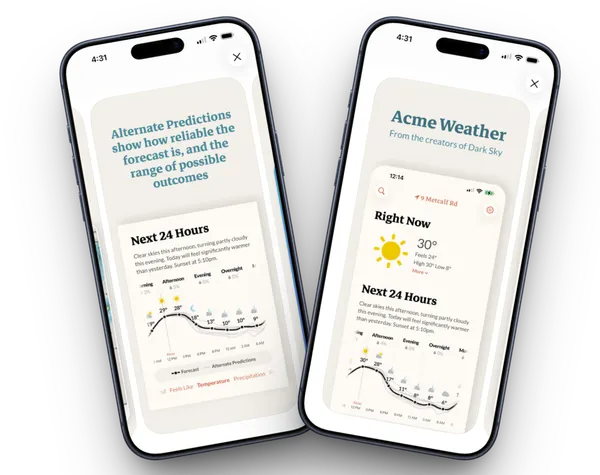
The people who built Dark Sky went to work inside Apple. They built WeatherKit — the developer API that now powers third-party weather apps across the App Store. By co-founder Adam Grossman's own account, they enjoyed their time there. But enjoyment and creative latitude aren't the same thing, and in February 2026, Grossman and the Acme Weather team made that gap visible when they launched an entirely new weather app — bootstrapped, independent, and built on their own forecast stack rather than licensing the Apple technology they helped create. The message encoded in that decision is louder than anything they've said in an interview.
Primephonic and the 19-Month Silence: The Apple Acquisition Nobody Covered
Dark Sky generated headlines because its user base was vocal and the Android shutdown was immediate. Primephonic got far less attention, which is almost more troubling.
Primephonic was a classical music streaming service built specifically for listeners who found Spotify's classical catalog presentation frustrating — which is everyone who takes classical music seriously. It had curated playlists organized around composers, periods, and ensembles rather than mood playlists, lossless audio before Apple Music offered it broadly, and an interface that treated classical music as its own discipline rather than a niche genre category.
Apple acquired Primephonic in August 2021 and immediately closed new subscriptions. Existing subscribers were told access would end. There was no transition plan beyond a short window to export listening history — just a shutdown and a promise that a "new classical music experience" was coming to Apple Music "next year."
"Next year" turned out to be April 2023. For 19 months in between, Primephonic users had nothing. No app, no alternative from Apple, no acknowledgment that they were absorbing the cost of Apple's product development schedule. Apple Music Classical eventually launched and is by most accounts a genuine improvement for classical listeners — but it requires an Apple Music subscription, runs only on Apple devices, and displaced a cross-platform service that had built a real audience. Apple replaced it with something better for Apple's business model. Whether it's better for every Primephonic user is a different question.
Workflow and Shortcuts: The One Time an Apple Acquisition Made the App Better
The counterargument in every discussion of Apple's acquisition history is Workflow. Apple acquired the iOS automation app in 2017, renamed it Shortcuts, baked it into the operating system at iOS 12, and transformed a capable indie utility into something dramatically more powerful. Shortcuts can do things Workflow never could, because platform-level system access was the ceiling the original app was always hitting.
This acquisition worked, and it's worth understanding exactly why — because the reason doesn't apply to most apps. Workflow was always infrastructure. It was a tool that needed to be part of the operating system to reach its potential. Users who mourned the Workflow name found Shortcuts gave them everything they'd wanted and more.
Most beloved apps aren't infrastructure. They're products with voices, creative sensibilities, community relationships, and design philosophies that belong to their makers. Dark Sky had a distinctive visual personality and forecast philosophy. Primephonic had an editorial approach to classical music that reflected real curatorial expertise. Pixelmator Pro has a design philosophy that has historically been described as more Apple-like than Apple itself. That's what gets lost when the acquisition closes and the corporate machinery absorbs the team. Not necessarily the features. The intentionality.
The Beats Exception: Why Some Acquisitions Survive — And What That Tells You
Before accepting that Apple always absorbs and eventually kills the things it buys, it's worth examining the case that most visibly breaks the pattern: Beats.
Apple acquired Beats Electronics in 2014 for $3 billion — its largest acquisition ever at the time. More than a decade later, Beats still exists as a standalone brand. The headphones still sell. The logo is still everywhere. Apple hasn't folded it silently into AirPods or stripped it for parts. Why?
The answer sharpens the acquisition thesis rather than undermining it. Beats survived because it brought Apple something Apple couldn't manufacture internally: cultural credibility. Dr. Dre and Jimmy Iovine didn't just have headphones — they had relationships with the music industry that Apple needed to build Apple Music, a streaming service it was racing to launch against Spotify. Beats Music, the streaming service, became Apple Music's foundation. The headphone hardware kept selling because it occupied a different price and aesthetic segment than AirPods, serving youth and fitness audiences that AirPods didn't fully reach. Iovine himself joined Apple and spent years shaping its music strategy before quietly departing in 2018.
What Beats had that Dark Sky didn't: recurring revenue from hardware Apple could keep selling, brand equity that genuinely extended Apple's reach into markets it wasn't winning, and cultural relationships that Apple needed to operate — not just improve — a core business. Beats was useful to Apple as a brand. Dark Sky was useful to Apple as a set of patents and engineers. The moment WeatherKit was built and the Weather app was rebuilt, Dark Sky's continued existence became a liability rather than an asset — a competitor that Apple itself was funding.
The Beats comparison offers a useful framework: Apple preserves what it has ongoing commercial use for. It sunsets what it has already extracted value from. That calculus is entirely rational from Apple's perspective. It is, however, entirely disconnected from whether the app mattered to you.
Pixelmator Pro: An Early Signal That This One Might Be Different
The early read on Pixelmator is more encouraging than the pattern would suggest — and that's worth saying plainly rather than forcing it into the Dark Sky narrative where it doesn't fit.
The acquisition completed in February 2025. By January 2026, Pixelmator Pro had received a meaningful update — not a vague "bug fixes and improvements" release, but a substantive one. More tellingly, Apple has folded Pixelmator Pro into Creator Studio, its emerging suite of creative tools. That's not the move of a company planning to quietly sunset an app. It's the move of a company integrating it into something larger, which maps much more closely to the Logic Pro trajectory than the Dark Sky one.
None of that means the outcome is guaranteed. Apple has absorbed apps into broader platforms before and still eventually wound them down once the integration was complete. And Pixelmator's inclusion in Creator Studio raises its own questions: does this mean the standalone app survives on its own merits, or does it become a feature inside a subscription bundle that changes the economics for existing one-time-purchase users? Those answers aren't here yet.
But the honest assessment, based on what's actually happened rather than what the pattern predicts, is that Pixelmator Pro looks more like a product Apple intends to invest in than one it's warehousing on the way to the exit. If that holds, it would make Pixelmator a genuinely rare outcome — a creative app acquired by Apple that emerged on the other side with more resources, more reach, and its core purpose intact. That would be worth recognizing. It just hasn't fully played out yet.
What Apple's Acquisition Pattern Really Reveals
Apple doesn't acquire apps to be stewards of independent creative work. It acquires apps to solve platform problems — to fill gaps in its own product lineup, to recruit talent it couldn't otherwise attract, to eliminate competitive alternatives on the platform it controls, or to integrate capabilities that function better as OS-level features than as standalone products. These are rational business reasons. They just aren't the same as caring about what the app meant to its users.
The indie development community has largely internalized this as a fact of life — and it produces a specific, uncomfortable silence. The term for what Apple does to apps it doesn't acquire but still neutralizes is "sherlocking" — when Apple builds a native feature that replicates what a third-party app does, effectively making it redundant. Former Apple executive Phillip Shoemaker has described fielding constant complaints from small developers angry that Apple had copied their work. But most say nothing publicly. "People are afraid of getting chopped off the App Store because they say the wrong thing or do the wrong thing," Shoemaker told NPR. The platform that distributes your app is the same company that can render it obsolete or acquire it for a fraction of what it might be worth if competitors existed. That's not a partnership. It's a dependency.
The acquisition calculus flows from the same power structure. You build something great, Apple notices, Apple acquires it, and then you either get the Logic treatment or the Dark Sky treatment — and there's no reliable way to know in advance which one you'll get. Both the Pixelmator team and the Dark Sky team used the same careful language about continuity when their acquisitions were announced. The early signals are pointing in different directions.
There's also a broader dynamic worth naming. Apple controls the only legal distribution channel for iOS apps. That's not incidental to the acquisition story — it's central to it. When Apple acquires a competitor to one of its built-in apps, it isn't just buying a company. It's removing a rival from the only store where iPhone users can shop. Dark Sky couldn't have stayed on iOS indefinitely as a thorn in Apple Weather's side even if it had wanted to — not because Apple would have violated App Store rules to kill it, but because the economics of running a subscription weather app on a platform controlled by your new parent company simply don't function the same way they did before. The acquisition resolves the tension by ending it. That's not conspiracy. It's just the geometry of the platform.
For developers watching from the outside, that geometry creates a specific kind of calculation. Building something great enough to attract Apple's attention is simultaneously the dream and the risk. An acquisition offer is life-changing money, validation of years of work, and — for the users who built their habits around your product — the beginning of an uncertain countdown. The developer wins. Apple wins. The user just waits to find out which version of this story they're in.
The most instructive signal remains the Dark Sky team itself — now back outside Cupertino, building Acme Weather on their own terms with their own forecast infrastructure. They know what happens inside Apple better than any outside observer. They chose to leave anyway, and chose to compete directly in the same space where their first product was acquired and absorbed. Whatever diplomatic language surrounded the original deal, that choice says something the blog posts couldn't.
Pixelmator's story is still being written. The early chapters look better than most acquisitions manage. Whether the ending holds is a question Apple will answer on its own schedule — and users, as always, will be the last to know.
Frequently Asked Questions: Apple App Acquisitions
What happened to Dark Sky after Apple acquired it?
Apple acquired Dark Sky in March 2020. The Android app was shut down immediately after the acquisition. The iOS app continued until January 2023, when it was shut down entirely. Apple incorporated Dark Sky's technology and team into its built-in Weather app and the WeatherKit developer API.
What is Acme Weather and how does it relate to Dark Sky?
Acme Weather is a new iOS weather app launched in February 2026 by the co-founders of Dark Sky, including Adam Grossman, Josh Reyes, and Dan Abrutyn. After the Dark Sky acquisition, the team worked inside Apple on WeatherKit. They left Apple to build Acme Weather independently, using their own numerical weather forecast models rather than licensing Apple's technology.
Will Pixelmator Pro be shut down by Apple?
As of early 2026, the signs are more encouraging than the historical pattern would suggest. Pixelmator Pro received a substantive update in January 2026 and has been included in Apple's Creator Studio suite. Whether Apple maintains it as a standalone product long-term or eventually folds it into a broader subscription offering remains to be seen, but the early trajectory looks closer to Logic Pro than to Dark Sky.
Which Apple app acquisitions were successful for users?
Logic Pro (acquired with Emagic in 2002), Final Cut Pro, Shazam, Workflow (now Shortcuts), and Beats Electronics are the most cited examples of Apple acquisitions that preserved or improved the original product's value for users. Beats is particularly notable — the brand and hardware line survived intact because Apple had ongoing commercial use for both the products and the cultural relationships the founders brought to Apple Music.
Why does Apple acquire popular apps?
Apple's acquisitions typically serve one of several strategic purposes: acquiring engineering talent, integrating technology into built-in iOS/macOS features, eliminating cross-platform competition, or filling gaps in Apple's professional software lineup. Apple acquires approximately 20–25 companies per year, the vast majority of which are never publicly announced.


Discussion