
It took the better part of a decade, a forced product redesign, an import ban that pulled Apple Watches off US store shelves for weeks, and a $634 million jury verdict that Apple is still appealing. But on April 17, 2026, the International Trade Commission declined to review an earlier ruling that Apple's redesigned blood oxygen feature does not infringe Masimo's patents, effectively closing the case and ending Masimo's bid to reinstate an Apple Watch import ban for good.
For Apple, this is about as complete a vindication as a legal fight can produce. For the rest of the tech industry, this saga is a masterclass in how a determined competitor can weaponize patent law against a larger rival, and why that strategy has limits.
How a 2013 Hiring Decision Became a Decade of Litigation
The seeds of this dispute were planted before most consumers had ever heard of pulse oximetry. In 2013, Masimo accused Apple of recruiting its top engineers to develop competing pulse oximetry technology for a watch product that did not yet exist. When Apple launched blood oxygen monitoring with Apple Watch Series 6 in 2020, Masimo had its opening.
By 2023, the ITC had ruled that Apple's implementation infringed on two Masimo patents, and issued an import ban on Apple Watch Series 9 and Ultra 2 models with the feature active. Apple's response was to disable it via software, keeping watches on shelves but stripping a health capability from devices customers had already paid for. That workaround held only temporarily. The ban was reinstated in January 2024, and Apple began selling watches with the feature fully disabled. US customers buying certain Apple Watch models spent over a year and a half unable to access blood oxygen monitoring at all.
The financial stakes escalated further in November 2025 when a federal jury awarded Masimo $634 million in a separate civil suit over a patent that expired in 2022. Apple called the verdict a product of "historic patient monitoring technology from decades ago" and immediately signaled an appeal. Across the full span of this dispute, Apple says Masimo has asserted more than 25 patents, "the majority of which have been found to be invalid."
The Redesign That Changed Everything
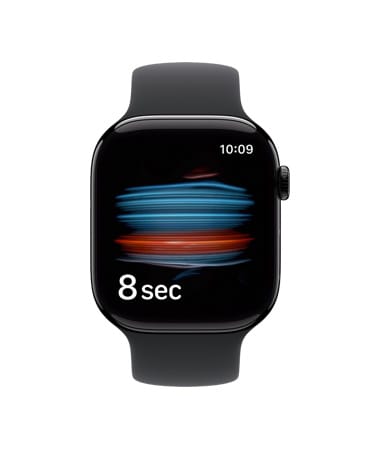
Apple's path out of the ban was not litigation alone. It was engineering. In August 2025, Apple reintroduced blood oxygen monitoring through iOS 18.6.1 and watchOS 11.6.1 with a fundamentally different architecture: the Apple Watch collects raw sensor data, but all the actual calculations happen on the paired iPhone. Results appear in the Respiratory section of the Health app, not on the watch itself.
This was not just a legal maneuver. It was a genuine technical pivot. Apple told US Customs and Border Protection that the redesigned implementation "definitively does not contain pulse oximetry functionality" that infringes Masimo's patents, and CBP agreed, clearing the feature for import in August 2025.
There is a real user experience tradeoff in this design. The wrist-level spot checks that originally made the feature convenient are gone. You cannot glance at your watch for a reading, and there are no SpO2 complications for the watch face. The data lives in the iPhone Health app, available for trends and historical review but not for the kind of in-the-moment awareness the original feature provided. For most users, that is probably acceptable. For the specific subset who used blood oxygen monitoring as part of altitude tracking or sleep wellness, the friction is noticeable.
Masimo predictably pushed back, arguing the redesign still fell within the scope of the existing exclusion order. The company challenged CBP's approval through the courts and filed petitions with the ITC seeking to invalidate the redesigned feature. ITC Administrative Law Judge Monica Bhattacharyya rejected those arguments in March 2026, concluding the accused redesigned products did not infringe Masimo's patents. The full Commission has now declined to review that finding, terminating the proceeding entirely.
What This Actually Means
Apple's statement in response was notably pointed: "For more than six years, Masimo has waged a relentless legal campaign against Apple, and nearly all of its claims have been rejected." That framing matters. Apple is not just celebrating a legal win. It is characterizing Masimo's entire strategy as a harassment campaign, and the ITC's string of rulings supports that characterization.
The import ban, as a weapon, is now spent. The original ban remains technically in effect for the original implementation of blood oxygen, but Apple is no longer selling that implementation in the US. The redesigned feature is cleared. Masimo can still appeal the latest decision, but the ITC has now closed the case, and the successive rounds of losses have dramatically narrowed Masimo's leverage.
There is a broader industry lesson here about the limits of the ITC as a competitive tool. The commission exists to protect legitimate intellectual property from infringing imports, not to allow competitors to extract licensing fees by tying up technology in procedural limbo for years. Apple's willingness to engineer its way around the ban, rather than settle, signals that it calculated the redesign cost was lower than the ongoing exposure of a licensing agreement. Given the outcome, that calculation looks correct.
The $634 million civil verdict is a separate matter, and not resolved by this ruling. Apple is appealing it, and the patent at issue expired in 2022. The damages figure will likely look very different before the appeals process concludes.
For Apple Watch customers in the United States, the practical result is that the feature is back, even if it works differently than it did before 2024. The longer-term question is whether Apple eventually restores on-watch processing now that the legal threat has cleared, or treats the iPhone-offloaded architecture as the permanent US solution. The original implementation is still banned. That ban has not been lifted. Apple would need a new proceeding or settlement to bring back wrist-level calculations, and given where relations with Masimo stand, a settlement seems unlikely in the near term.
Six years, two companies, over two dozen patents, one import ban, one $634 million verdict, and a forced redesign of a health feature that Apple's own CEO acknowledged was not a major sales driver. It was an expensive fight for both sides. Apple did not escape without costs. But it did not settle, it did not license, and it is the one still selling watches.


![Everything New in Apple's 26.5 Betas: RCS Encryption, Maps Changes, [Update - Beta 2]](/content/images/size/w800/2026/03/iOS-26.5-Beta-release-announcement.png)