

The healthcare AI race just got more interesting. OpenAI's announcement of ChatGPT Health marks a significant strategic pivot into the medical sector, and its integration with Apple Health positions it directly in the daily lives of millions of iPhone users. But beyond the surface-level convenience, this partnership reveals deeper implications about data control, privacy models, and the future of consumer health technology.
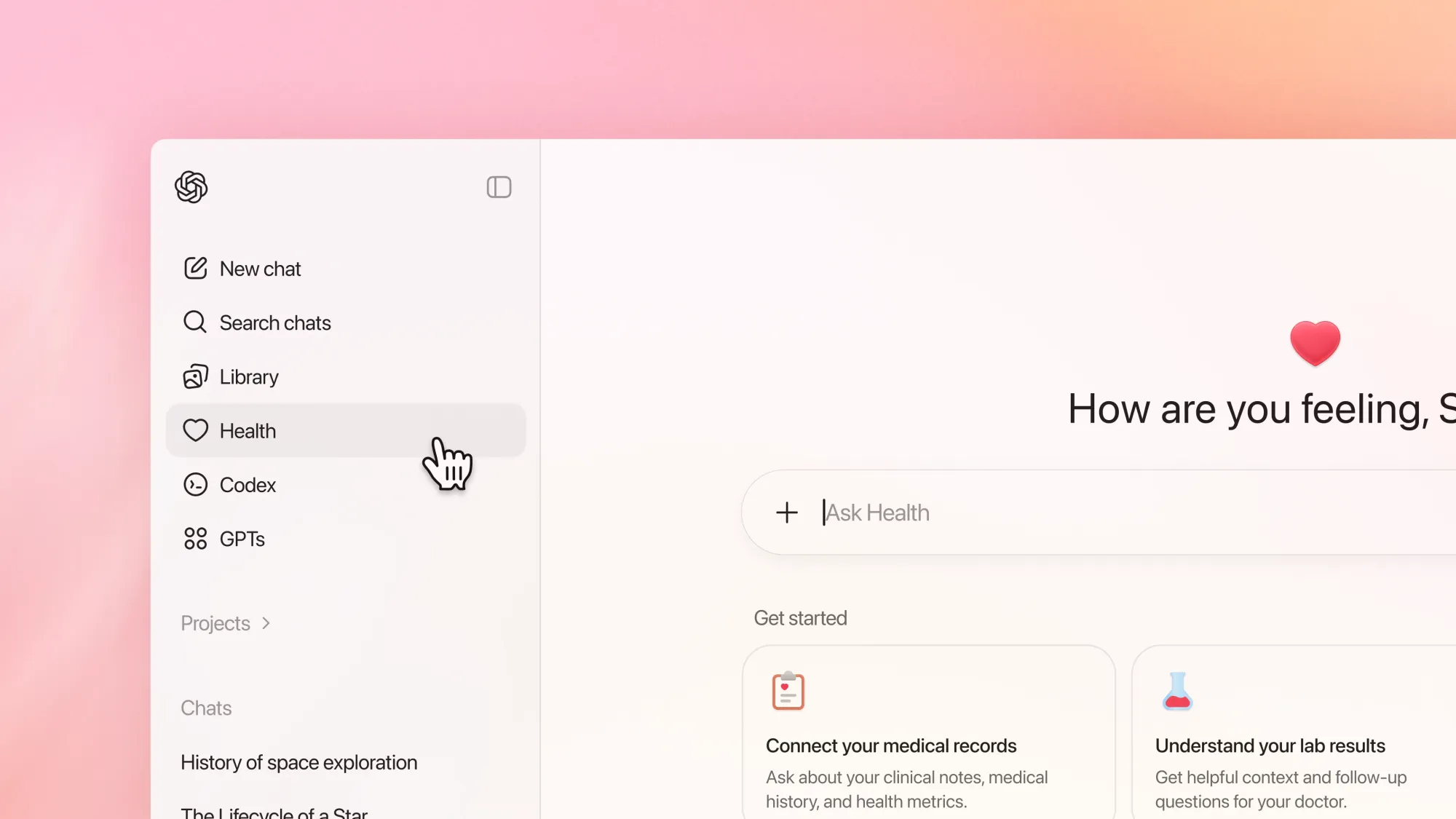
What ChatGPT Health Actually Does
ChatGPT Health isn't just ChatGPT with a medical knowledge update. OpenAI has positioned this as a specialized healthcare assistant that can access your Apple Health data to provide personalized health insights, answer medical questions in context, and help users understand their health metrics over time.
The Apple Health integration is the critical piece here. By tapping into the comprehensive data repository that iOS has been building since 2014—heart rate, sleep patterns, activity levels, nutrition logs, and even cycle tracking—ChatGPT Health can theoretically offer contextualized health advice that generic AI assistants cannot match.
During the announcement, OpenAI demonstrated scenarios where users could ask questions like "Why has my resting heart rate increased over the past month?" and receive analysis based on their actual Health app data, cross-referenced with factors like sleep quality and exercise patterns from the same timeframe.
The Apple Health Advantage
Apple Health integration isn't just a feature—it's a strategic moat. Apple has spent a decade building the most comprehensive consumer health data platform, integrating data from the Apple Watch, iPhone sensors, and thousands of third-party health apps and devices. This creates a unified health record that lives on your device.
For Apple users, this means ChatGPT Health isn't starting from zero. If you've been using an Apple Watch and tracking health metrics through Apple's ecosystem, you're sitting on years of longitudinal data that ChatGPT Health can now analyze. That's significantly more valuable than one-off symptom queries.
However, this also highlights what OpenAI is actually getting from this partnership: access to incredibly rich, structured health data at scale. While OpenAI emphasizes privacy—claiming that Health data processing happens on-device through Apple's HealthKit framework—the value proposition for OpenAI is clear. Training and refining healthcare AI requires vast amounts of real-world data, and Apple's user base provides that at unprecedented scale.
Privacy Theater or Genuine Protection?
OpenAI's privacy messaging around ChatGPT Health deserves scrutiny. The company states that Apple Health data remains on-device and is processed through HealthKit's privacy framework, with no raw health data sent to OpenAI's servers. Instead, only anonymized, aggregated insights are transmitted when users ask questions.
For Apple users accustomed to the company's privacy-first messaging, this should sound familiar—and potentially reassuring. Apple has consistently positioned on-device processing as a privacy advantage, from Face ID to Apple Intelligence features. If ChatGPT Health truly leverages this same architecture, it represents a meaningful privacy implementation rather than marketing speak.
But there's complexity here. When you ask ChatGPT Health a question, that question—and potentially metadata about your health inquiry—travels to OpenAI's servers. The line between "anonymized insights" and identifiable health information can blur quickly, especially with longitudinal queries that might reveal unique patterns.
Apple users should recognize that this isn't Apple building health AI—it's OpenAI building on Apple's platform. The trust relationship is different. You're not just trusting Apple's track record on privacy; you're trusting OpenAI's implementation within Apple's frameworks.
What This Means for Apple's Health Strategy
OpenAI's move into health with Apple Health integration raises questions about Apple's own health AI ambitions. Apple has been methodically building health capabilities—ECG monitoring, blood oxygen sensing, sleep tracking, temperature sensing for cycle tracking, and most recently, sleep apnea detection. The roadmap clearly points toward more sophisticated health insights.
So why would Apple enable a third-party AI assistant to access this strategic data advantage?
The most likely explanation: Apple recognizes that generative AI for healthcare requires capabilities and regulatory navigation that differ from its core competencies. By allowing ChatGPT Health integration through HealthKit, Apple maintains its privacy framework and platform control while letting OpenAI take on the medical liability and regulatory complexity of providing health advice.
This is strategic delegation, not surrender. Apple controls the data pipeline, the privacy model, and ultimately the platform rules. If ChatGPT Health succeeds, it validates the health data Apple has been collecting. If it fails or causes regulatory problems, Apple maintains distance.
For Apple users, this could mean the best of both worlds: access to cutting-edge health AI without Apple having to become a healthcare company.
The Enterprise Health Angle
While consumer applications dominate the announcement coverage, ChatGPT Health's Apple Health integration has significant implications for enterprise healthcare. Many healthcare providers already use iPads in clinical settings, and Apple has made enterprise healthcare pushes with features like Health Records integration.
ChatGPT Health could become a clinical decision support tool for providers, analyzing patient-reported Apple Health data during telehealth visits or between appointments. The longitudinal data from patients' personal devices could provide clinicians with insights that traditional episodic care models miss entirely.
However, this also introduces complex regulatory considerations. Clinical use of AI assistants falls under FDA oversight in many cases, and the liability landscape for AI-generated medical advice remains unsettled. OpenAI's careful positioning of ChatGPT Health as an "assistant" rather than a diagnostic tool reflects this regulatory reality.
Technical Implementation Questions
From an implementation perspective, several technical questions remain about how ChatGPT Health actually works with Apple Health data:
On-device processing limitations: Apple Silicon's Neural Engine enables sophisticated on-device ML, but large language models like GPT-4 typically require server-side processing. How much health data analysis actually happens on-device versus in the cloud determines the real privacy equation.
HealthKit data access scope: Apple's HealthKit requires explicit user permission for each data type. Will users grant ChatGPT Health blanket access to all health data, or will permission fragmentation limit the assistant's effectiveness?
Data synchronization: Apple Health data syncs across devices through iCloud. How does ChatGPT Health handle health data from multiple devices (iPhone, iPad, Apple Watch), and what happens when data conflicts exist?
These aren't just technical minutiae—they fundamentally affect how useful and trustworthy ChatGPT Health becomes in practice.
The Competitive Healthcare AI Landscape
OpenAI isn't alone in pursuing healthcare AI. Google has been developing Med-PaLM for medical question-answering, Microsoft has healthcare-focused AI through its Nuance acquisition, and numerous startups are building specialized health AI assistants.
What differentiates ChatGPT Health is the Apple integration. Google has its own health platform through Google Fit and Fitbit, but it lacks the comprehensive, decade-long data accumulation that Apple Health represents. Microsoft has enterprise healthcare partnerships but minimal consumer health data.
For Apple users specifically, the question becomes: will Apple eventually build competing functionality into Apple Intelligence, making ChatGPT Health redundant? Apple's pattern suggests it builds platform capabilities that third-party apps leverage, but it also has a history of eventually integrating popular third-party functionality into iOS.
What Apple Users Should Actually Do
If you're an Apple user considering ChatGPT Health, here's the practical reality check:
Wait for the privacy deep-dive: Before connecting years of health data to a third-party service, wait for independent security researchers to analyze exactly how data flows between your device and OpenAI's servers.
Understand the liability limits: ChatGPT Health, like all AI assistants, won't provide medical diagnoses or replace physician consultation. Know what it can and cannot do before relying on its advice.
Review your HealthKit permissions: If you do enable ChatGPT Health, start with limited data access and expand only as you become comfortable with how the service uses your information.
Keep perspective on longitudinal value: The real power of ChatGPT Health isn't answering one-off health questions—it's analyzing patterns over time. If you're new to Apple Health tracking, the value proposition is limited until you build a data history.
The Bigger Healthcare AI Picture
ChatGPT Health represents a broader trend: consumer AI assistants moving beyond information retrieval into domains requiring domain expertise and personal data integration. Healthcare is the obvious next frontier because the stakes are high and the information asymmetry between medical professionals and patients creates clear value for AI intermediation.
But healthcare also represents AI's biggest challenges: accuracy requirements are higher, privacy concerns are more severe, and regulatory oversight is substantially more complex than for general-purpose chatbots.
For Apple users, the Apple Health integration makes this more than a theoretical exercise. Your iPhone already collects comprehensive health data. The question isn't whether AI will eventually analyze that data—it's who will do it, under what privacy model, and with what level of medical accuracy.
OpenAI's announcement doesn't answer all those questions, but it does make them immediately relevant to millions of people carrying iPhones with years of health data already stored.
Final Analysis
ChatGPT Health with Apple Health integration is strategically significant for OpenAI, potentially valuable for users, and revealing about Apple's health strategy. It's not revolutionary technology—AI health assistants have been promised for years—but it's the first major implementation with access to truly comprehensive consumer health data at scale.
For Apple users, the recommendation is cautious optimism tempered with privacy vigilance. The potential for personalized health insights based on your actual data is compelling, but the long-term privacy implications of connecting years of intimate health information to a third-party AI service remain to be fully understood.
This isn't just another AI feature announcement. It's the beginning of how artificial intelligence will mediate our relationship with our own health data—and for Apple users, that relationship is about to get significantly more complex.






Discussion