
The AI Memory Crisis Is Dismantling the Handheld Gaming Market in Real Time
The AI-driven RAM crisis is cancelling handhelds, doubling prices, and wiping out the market's momentum. Here's what's happening and why it won't resolve quickly.

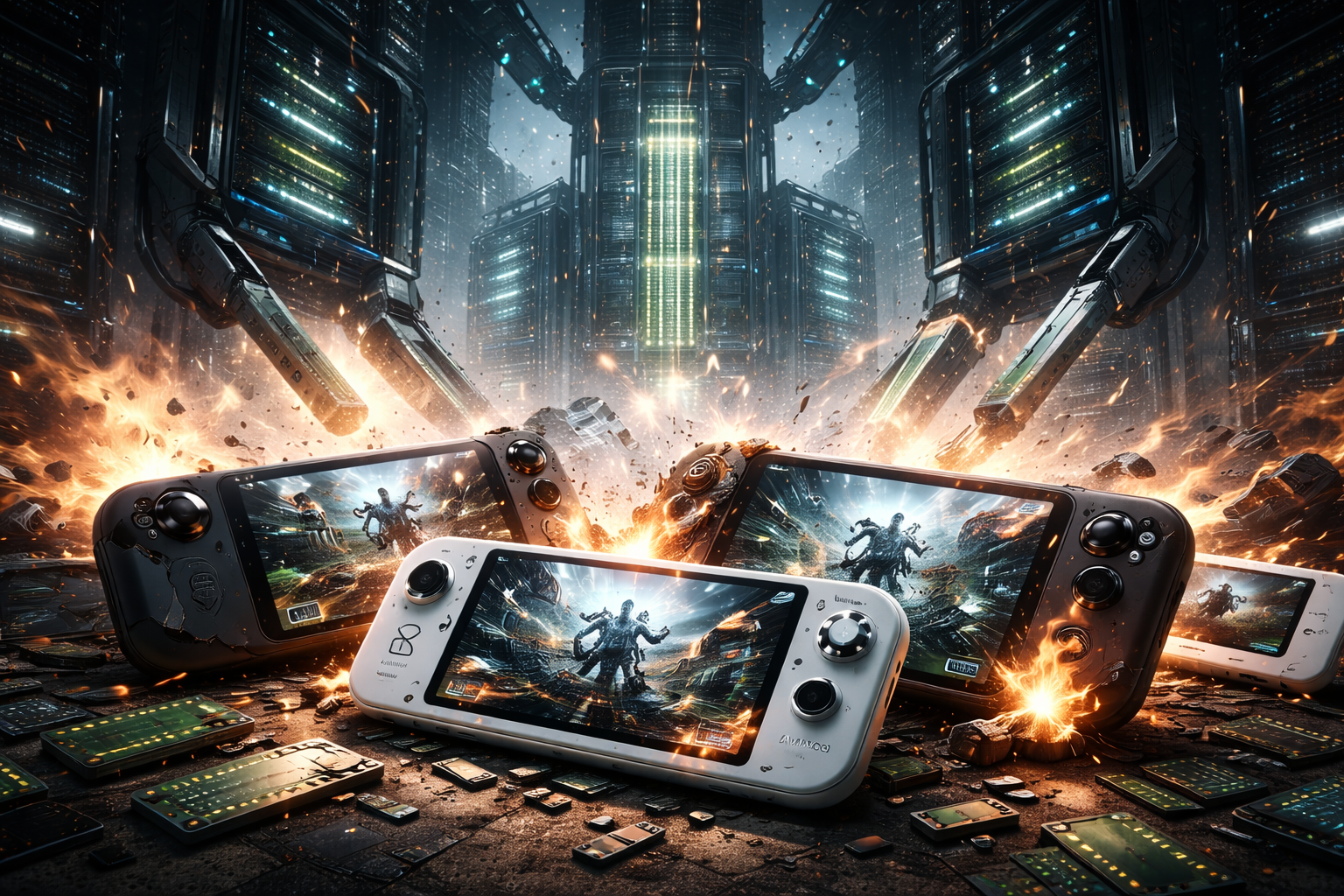
The gaming handheld market spent the last three years becoming something real. The Steam Deck proved there was genuine demand for PC gaming in your pocket. Retroid and Ayaneo carved out enthusiast niches. Lenovo and Asus brought legitimate corporate muscle to a category that had previously been dominated by one-off Kickstarters and Chinese boutique builders. It felt, finally, like the market had arrived.
Then the AI industry showed up and ate all the RAM.
What's happening right now to gaming handhelds is the story of a fragile, still-maturing market colliding head-on with a structural disruption it has almost no power to resist. The results are ugly: cancelled devices, price spikes that would make your jaw drop, and once-beloved products going out of stock with no clear restock date. This isn't a temporary supply hiccup. It's a glimpse at what the next two to three years look like for an industry that was just beginning to find its footing.
The Shortage Nobody in Gaming Saw Coming
The proximate cause is what analysts and enthusiasts have taken to calling the RAMpocalypse or RAMageddon: a severe global shortage of DRAM driven almost entirely by the AI industry's insatiable appetite for memory. AI data centers rely on high-bandwidth memory (HBM) and LPDDR chips to power the massive model inference and training workloads that companies like OpenAI, Google, and Microsoft run around the clock. The chip fabs at Samsung, SK Hynix, and Micron have responded by reallocating production lines away from consumer DRAM and toward the premium, high-margin memory that AI customers will pay extraordinary prices to secure.
The math is stark. According to TrendForce, DRAM contract prices climbed roughly 90 to 95 percent in just the first quarter of 2026. IDC has noted that memory, which used to represent about 15 to 18 percent of a PC's bill of materials, now accounts for closer to 35 percent. HP has confirmed the doubling. OpenAI alone reportedly secured 40 percent of the world's available DRAM supply for the foreseeable future. And data centers are projected to consume 70 percent of all memory chips manufactured in 2026, according to Tom's Hardware's reporting. Consumer electronics, sitting at the bottom of that priority stack, are effectively rationing what's left.
There is no near-term fix. New fabrication plants, including Micron's Idaho facility and SK Hynix's Yongin cluster, won't reach meaningful production volume until 2027 at the earliest. One recent Counterpoint Research report found that there is "no scenario where memory prices correct in the second half of 2027." IDC, in its updated forecast, explicitly stated that it does not expect prices to revert to 2025 levels within its forecast horizon. The Phison CEO put it even more bluntly, warning that many consumer electronics manufacturers will "go bankrupt or exit product lines" by the end of 2026.
For mainstream PC and laptop manufacturers, this is painful but survivable. Dell and Lenovo have announced 15 to 20 percent price increases. Framework raised its desktop prices by as much as $460. These are significant, but they're adjustments. For the gaming handheld market, which operates on thinner margins, smaller production runs, and a customer base that's already extremely price-sensitive, the same crisis is something closer to existential.
The Casualties Are Piling Up
The most dramatic story is Ayaneo's NEXT 2. Unveiled as a flagship Windows handheld built around AMD's Strix Halo APU, the NEXT 2 was supposed to represent everything the category could become at the high end: desktop-class performance in a portable chassis, a nine-inch OLED display, and a level of raw power that would make the Steam Deck look like a warm-up act. It launched on Indiegogo in early 2026 starting at $1,999, with a top-end configuration pairing the Ryzen AI Max 395+ with 128GB of RAM and a 2TB SSD priced at $4,299.
Less than two months after pre-orders opened, Ayaneo pulled the product from all sales channels. In a statement to backers, the company said the overall cost of the product had become "far higher than our current selling price" and that continuing sales was "no longer sustainable." The memory shortage had pushed the cost of the top configuration to nearly twice the original price — meaning a device that was already niche at $4,299 would have needed to retail somewhere around $8,000 to $8,600 to avoid losses. Ayaneo is honoring all existing pre-orders, but new customers cannot buy one. The company says the suspension is temporary and that sales will resume "if market conditions allow." Given the projections, that is doing a lot of work as a conditional statement.
Retroid, the maker of some of the most beloved mid-range Android handhelds on the market, has been hit across multiple product lines in a matter of weeks. In early March, Retroid discontinued the 12GB version of the Retroid Pocket 6 outright, citing rising memory costs. Two weeks later, the company announced the Retroid Pocket G2 — a device that had only launched in October 2025 — was being "temporarily discontinued" due to "ongoing fluctuations in memory pricing." The Retroid Pocket Classic received a $20 price increase simultaneously. AYN, another Chinese handheld maker, raised prices on its Odin Thor and Odin 3 devices and shelved the Odin 3 Ultra. Ayaneo's newer KONKR brand announced that the Pocket FIT 8 Elite's upcoming restock "will very likely be the final production batch." A device brand announced in January 2026 is already winding down four months later.
Then there's Valve. The Steam Deck OLED, which had been one of the most reliably available gaming handhelds on the market, quietly disappeared from shelves across the United States in mid-February. Valve eventually acknowledged the obvious: the OLED is out of stock "intermittently in some regions due to memory and storage shortages." By late February, the shortage had gone global, with the Steam Deck unavailable across Germany, Austria, Poland, France, Canada, and Japan. The LCD model, already discontinued, is gone for good. There's no confirmed restock timeline and no indication of whether the OLED will return at its current price. Valve previously had three additional hardware launches planned for early 2026, including the Steam Machine, Steam Frame VR headset, and a new Steam Controller. All three have been delayed with pricing still undetermined. Valve has essentially said it cannot commit to prices in a market where component costs are changing faster than it can plan around them.
The Lenovo Legion Go 2, arguably the most powerful Windows gaming handheld on the market when it launched in October 2025, has seen its price increase by nearly 50 percent in five months without any formal announcement from Lenovo. The base model with the AMD Ryzen Z2 and 16GB of RAM climbed from $1,099 to $1,499 — a 36 percent jump. The top-tier configuration with the Ryzen Z2 Extreme and 32GB of RAM went from $1,349 to $1,999, a $650 increase. Both models are currently listed as unavailable at Best Buy. Pre-tax, the top Legion Go 2 is already at the two-thousand-dollar mark. Post-tax, it clears it. For context, that's the same price as a capable gaming laptop with meaningfully better thermals, a larger screen, and more upgradeability. The value proposition, always a stretch for the Legion Go 2 given its already-premium launch pricing, has collapsed.
What's notable about the Legion Go 2 situation is the contrast with the Asus ROG Xbox Ally X, which is powered by the same AMD Ryzen Z2 Extreme chip and has held its $999 price. The difference likely comes down to how each company sources memory: Lenovo's approach to component procurement appears to have left it more exposed to spot market pricing, while Asus may benefit from AMD bundling the integrated memory with its APUs directly. It's a useful illustration of how the shortage is hitting companies unevenly, and how supply chain strategy is suddenly one of the most consequential decisions a hardware company can make.
What This Actually Signals About the Market
The easy narrative here is that the AI boom is temporarily disrupting handheld gaming and things will return to normal eventually. That framing undersells how structurally precarious the market was before any of this started, and how much the memory crisis is accelerating problems that were already latent.
The Windows handheld category has always been a market of enthusiasts buying expensive hardware to run software that wasn't designed for it. Windows 11 on a seven- or eight-inch touchscreen is, at its best, tolerable with the right launcher software on top. The devices that have sold have done so because the hardware was compelling enough to justify the compromise. When that hardware starts costing two thousand dollars, the number of people willing to make that bet shrinks dramatically. Ayaneo, GPD, OneXPlayer, and the other boutique Windows handheld makers were already operating at the fringes. The memory crisis isn't just raising their costs. It's potentially eliminating their market.
The mid-range Android handheld space — Retroid, AYN, Ayaneo's retro sub-brand KONKR — is in a different but equally difficult position. These devices compete on price-to-performance. They're bought by retro gaming enthusiasts who have a precise sense of what a device should cost and how much performance they can expect for it. A $219 Retroid Pocket G2 makes sense. A $319 Retroid Pocket G2, which is roughly where the memory math would push it, probably doesn't — not when the Retroid Pocket 6 exists at a higher price point with meaningfully better specs. These companies don't have the option to simply absorb the increase or pass it quietly to customers. They're discontinuing products because there's no price at which the product can be sold without either losing money or losing the market.
Even Valve, which has more resources than any of the boutique builders and a stronger brand than most, is clearly struggling to navigate this. The Steam Deck's success was built on an aggressive price point: $399 at launch for the base model, with Valve historically willing to take a loss or minimal margin to grow the platform. That model depends on predictable, affordable component pricing. The memory crisis removes the predictability, and the shortage removes the affordability. Whatever the Steam Deck's successor looks like — and Valve has been conspicuously quiet about Steam Deck 2 — it's going to cost more than anyone currently assumes. The same is true for the Steam Machine, which Valve has already acknowledged will need to price "competitively against entry-level gaming PCs" in a moment when entry-level gaming PCs are themselves getting significantly more expensive.
The longer-term implications reach beyond individual products. According to IDC, worldwide PC shipments are forecast to fall 10.4 percent in 2026 — the sharpest decline in over a decade. Gartner projects the sub-$500 entry-level PC segment will disappear by 2028. Sony is reportedly considering delaying the PlayStation 6 to 2029 to avoid launching into a hostile component market. Nintendo is weighing a Switch 2 price increase. The entire consumer electronics landscape is contracting around cost pressure, and the gaming handheld market, which has less institutional support than any of those platforms, is contracting faster.
The memory crisis is also quietly reshaping which companies will survive to build the next generation of handhelds. Boutique manufacturers without long-term supply agreements, significant cash reserves, or the leverage to negotiate favorable component pricing are being sorted out. That isn't inherently bad: market consolidation often precedes stability. But in the short term, it means fewer options, higher prices, and a return to a category defined primarily by a handful of larger players who can weather multi-year disruption. The experimentation and diversity that made 2024 and 2025 exciting for handheld gaming fans is, at least temporarily, over.
The Question Nobody Can Answer Yet
The fundamental question for anyone watching this market is whether the disruption is a compression or a break — whether the handheld gaming category emerges from this period smaller but intact, or whether the sustained pressure reshapes consumer expectations in ways that are harder to reverse.
There's a plausible optimistic case. New fab capacity comes online in late 2027 and into 2028. Memory prices stabilize and then decline. Valve launches a reasonably priced Steam Deck successor. Nintendo's deep software moat insulates the Switch 2 enough that even a modest price increase doesn't crater its installed base. The boutique Windows handheld makers that survive the shortage are leaner and better capitalized. The category recovers with fewer but stronger players.
The pessimistic case is harder to dismiss. Memory prices stay elevated well past 2028, because Samsung and SK Hynix have both signaled that they intend to minimize the risk of oversupply and are not rushing to build capacity that would depress the premium prices they're currently enjoying. The consumers who were priced out in 2026 don't come back: they drifted to phones, to older hardware, to subscription streaming services that let them play on devices they already own. The enthusiast hardware makers that folded don't rebuild. And the category, which spent years trying to broaden its audience beyond a core of determined PC gamers, finds itself back where it started, serving only the people willing to pay whatever it costs.
Right now, the Lenovo Legion Go 2 costs two thousand dollars and is impossible to buy. The Ayaneo NEXT 2 is frozen. The Steam Deck is out of stock globally. The Retroid Pocket G2 is discontinued five months after launch. Any one of those things would be a story. Together, they're a signal. The AI industry didn't set out to wreck handheld gaming. It just decided that it needed the memory more.
Written by

Subscribe to our newsletter
Subscribe to our newsletter to get the latest Apple updates and news





Member discussion