

Apple has released Xcode 26.3, introducing what may be the most significant shift in how developers build Apple platform apps in years: native agentic coding. For the first time, Xcode can work with AI coding agents — including Anthropic's Claude Agent and OpenAI's Codex — directly inside the IDE, handling complex, multi-step development tasks with a level of autonomy that goes well beyond a simple autocomplete or inline suggestion.
The release builds on the coding assistant Apple introduced in Xcode 26, which brought AI-assisted writing and editing in Swift. Xcode 26.3 takes that foundation and opens it up to full-blown agents capable of breaking down tasks, making architectural decisions, searching documentation, updating project settings, and even capturing Xcode Previews to visually verify their own work. The result is a workflow where developers can hand off more of the repetitive scaffolding work and focus on the problems only they can solve.
Xcode 26.3 is available as a release candidate to Apple Developer Program members, with a public App Store release coming soon.
Xcode 26.3
Agentic Coding
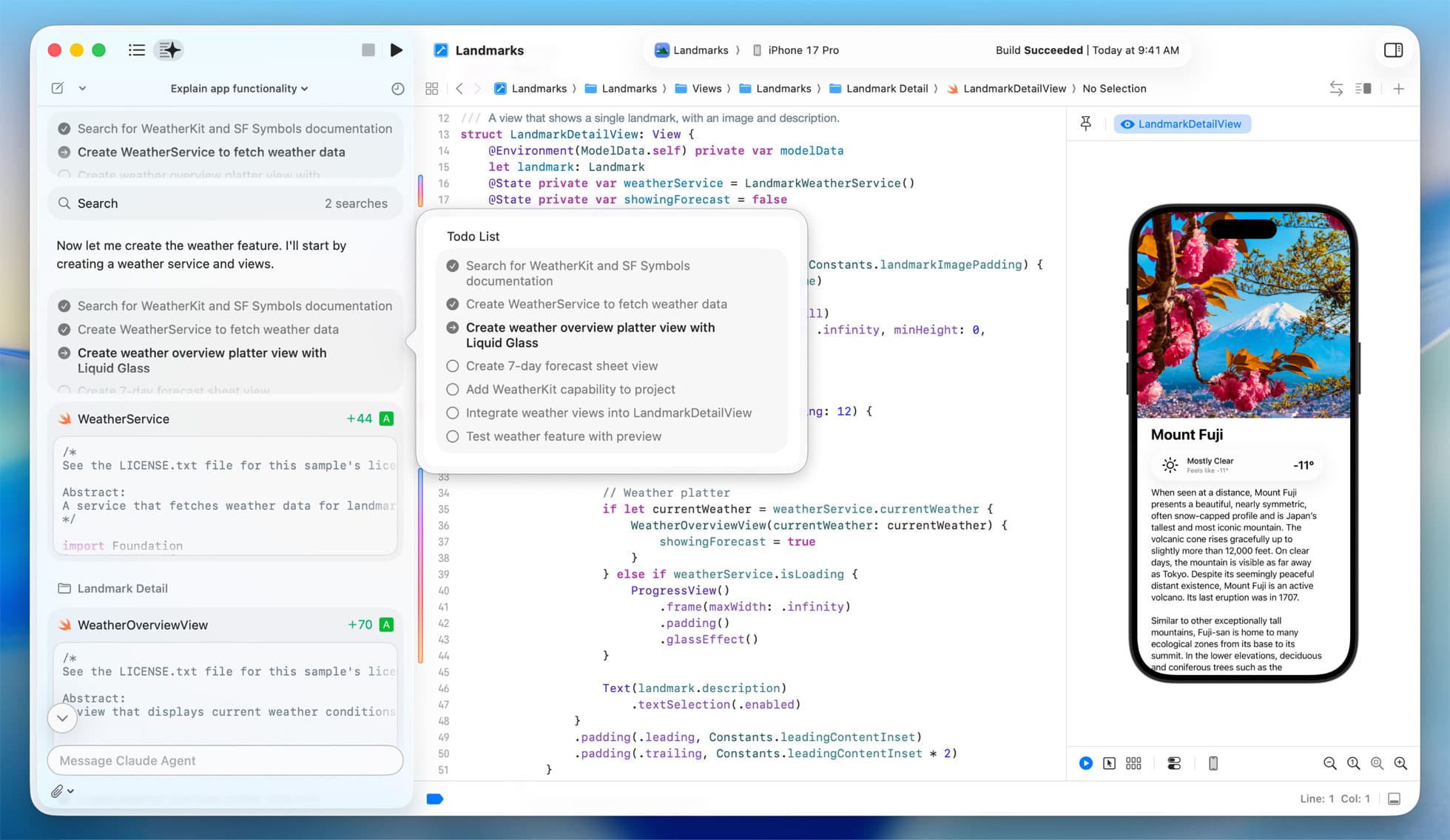
Agentic coding is the headline feature of this release, and it's worth understanding what separates it from the AI assistance developers are already used to. Most AI coding tools — copilots, inline completions, chat-based assistants — react to a prompt and produce output. The developer then evaluates that output and decides what to do next. Agents work differently: they receive a goal and pursue it across multiple steps, using tools and reasoning to adapt as they go.
In Xcode 26.3, agents like Claude Agent and Codex can explore a project's file structure, read and understand the architecture, search Apple developer documentation, update project settings, write and modify code, run builds, catch errors, and iterate — all in pursuit of a higher-level objective the developer sets. They can also capture Xcode Previews to confirm that UI changes look correct before moving on, effectively closing the loop between writing code and verifying results.
To use agentic coding, open Xcode 26.3 and access the new agent interface from within the IDE. From there, you can select your preferred agent — Claude Agent or Codex — and describe the task you want to tackle. The agent will begin working through the steps, and you can observe its progress, intervene, or redirect as needed. Claude Agent and Codex are both available as built-in integrations, and Anthropic's and OpenAI's terms of service apply to their respective agents.
The practical value here is significant for tasks that typically involve a lot of boilerplate or setup: standing up a new feature module, wiring up a networking layer, refactoring a view hierarchy, or adapting existing code for a new API. These are exactly the kinds of tasks where developers know what they want but spend disproportionate time on the mechanical execution.
Model Context Protocol Support
Beyond the built-in Claude Agent and Codex integrations, Xcode 26.3 opens its capabilities to the broader AI ecosystem through the Model Context Protocol (MCP). MCP is an open standard that allows any compatible agent or tool to connect with Xcode and access the same capabilities available to the built-in integrations.
This matters because it means developers aren't locked into Apple's two launch partners. Teams that have built internal tooling, that prefer a different model, or that want to build their own specialized coding agents now have a standardized way to connect those tools to Xcode's native functionality. MCP support signals that Apple isn't trying to close off agentic coding to a curated set of providers — it's establishing Xcode as a platform that agents can build on.







Discussion