
The Epic vs. Apple saga started with a deliberate provocation over Fortnite in-app purchases. It reaches its most consequential chapter yet with a federal court stripping Apple of the procedural shields it has used for years to avoid answering a simple question: what is a fair cut?
On August 13, 2020, Epic Games did something that any developer with a few million dollars in legal budget and a taste for theatrical protest could have done years earlier. It updated Fortnite with a direct payment option, letting players buy V-Bucks straight from Epic at a 20 percent discount and bypassing Apple's payment system entirely. The move violated App Store rules, and Epic knew exactly what would happen next.
Apple pulled Fortnite from the App Store within hours. Epic filed a lawsuit within minutes. It had written the complaint in advance.
The whole thing was choreographed, down to a parody video Epic published the same day: a recreation of Apple's iconic "1984" Super Bowl commercial, except now Apple was the authoritarian on screen and a Fortnite character swung the sledgehammer. It was designed to embarrass, to provoke, and to start a legal fight that Tim Sweeney, Epic's CEO, had clearly decided was worth having regardless of cost.
What followed was six years of courtroom battles that have quietly reshaped how app stores work, set precedent that now applies to every developer on the platform (not just Epic), and culminated this week in a ruling that finally strips Apple of the ability to keep delaying the inevitable.
What the Original Case Was Actually About
The popular framing of Epic vs. Apple is that it was a fight over Fortnite. It wasn't. Fortnite was the crowbar. The fight was about whether Apple's control over the only viable distribution channel for iOS apps, and its insistence on processing all payments through its own system at a 15 to 30 percent commission, constituted an illegal monopoly.
Epic's antitrust argument was ambitious. It asked the court to rule that Apple's App Store was itself a market, one that Apple monopolized illegally. If that argument had succeeded, the remedy would have been dramatic: potentially forcing Apple to allow competing app stores, third-party payment systems, and a wholesale restructuring of how the iOS ecosystem operates.
In September 2021, Judge Yvonne Gonzalez Rogers issued her ruling and Apple largely won. The court found Apple was not a monopolist. It did not hold illegal monopoly power under federal antitrust law. Epic's core argument failed.
But one thing didn't go Apple's way, and it turned out to matter enormously. The judge found that Apple's anti-steering policies, the rules that prevented developers from telling users inside apps that cheaper options existed elsewhere, violated California competition law. She issued an injunction: Apple had to let developers link users to external payment options.
Apple declared victory. Sweeney said they'd appeal. The Ninth Circuit largely upheld the ruling in April 2023. The Supreme Court declined to hear either side's appeal in January 2024. The anti-steering injunction was now settled law.
Compliance, Apple-Style
Here is where the case gets genuinely instructive, and where the pattern that courts have spent two years documenting becomes clear.
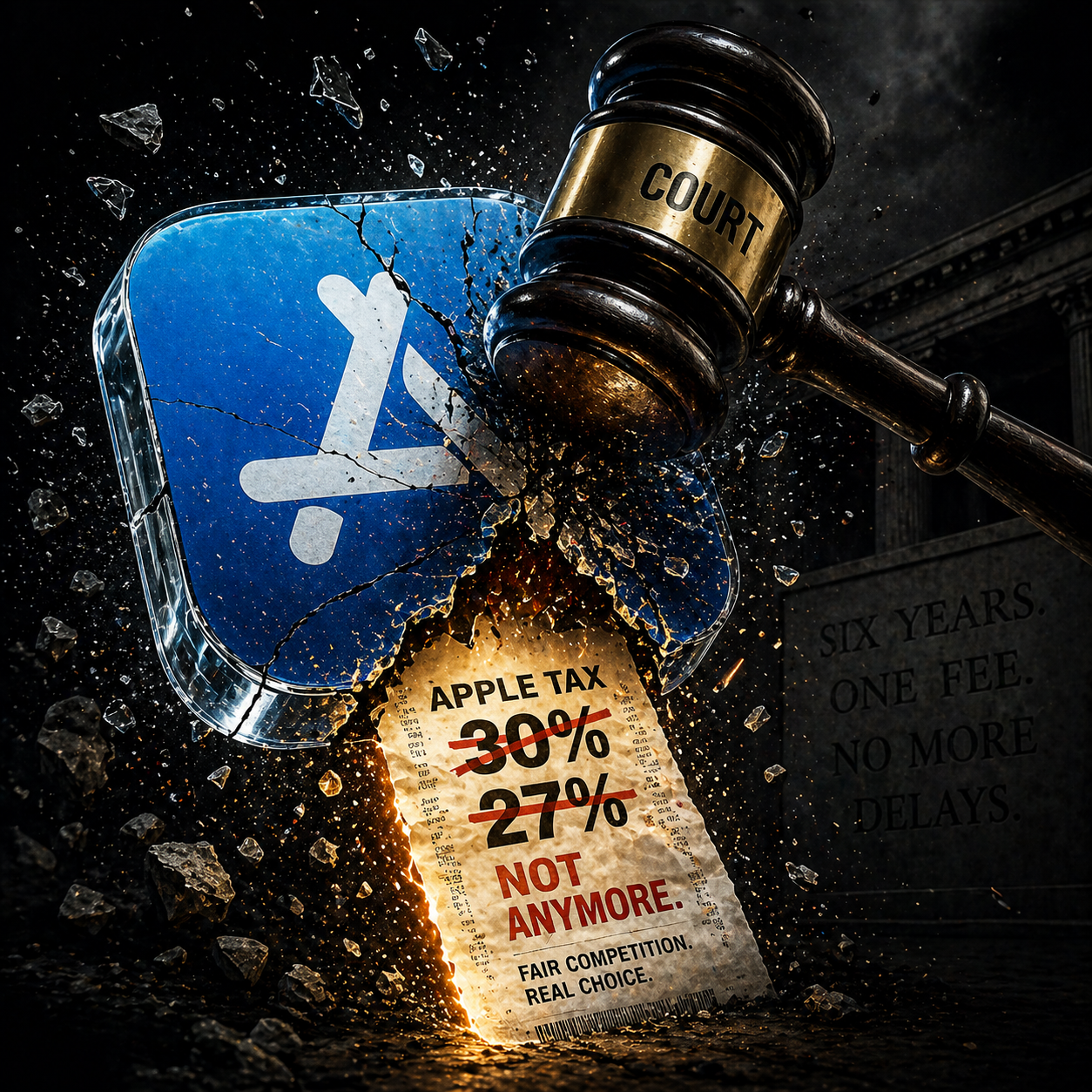
When Apple "complied" with the anti-steering injunction in early 2024, it did so in a way designed to make compliance structurally pointless. Developers who wanted to link users to outside payment options could do so, but Apple would charge a 27 percent commission on any purchases made through those external links. Apple's normal fee is 30 percent. The alternative payment path cost developers three percent less than just using Apple's system, while adding the friction of sending users off-platform.
Unsurprisingly, almost no developers adopted it. Spotify, Kindle, and Patreon were among the few who tried. Most simply looked at the math and declined.
Epic filed a contempt motion in March 2024, arguing Apple's implementation was designed to defeat the injunction rather than satisfy it. In April 2025, Judge Gonzalez Rogers agreed, forcefully. In an 80-page ruling, she found that Apple had "willfully" violated her injunction. Not accidentally. Not ambiguously. Willfully. She found that Apple had misled the court about the rationale for its fee structure and had deliberately constructed a compliance framework designed to preserve its anticompetitive revenue stream while appearing to follow the rules.
The remedy tightened the injunction significantly. Apple could no longer charge any commission on purchases made through external links, and it could no longer use interface design to discourage those purchases. The "scare screens" Apple had been displaying to warn users they were leaving the App Store were gone too.
The December 2025 Ruling and Why Apple Ran Out of Runway
Apple appealed again. In December 2025, the Ninth Circuit confirmed the contempt finding and upheld most of the expanded injunction, but with one modification. The court agreed Apple should be allowed to charge some fee on external purchases; it just couldn't be 27 percent. The specific rate was sent back to the district court to determine.
Apple asked for a rehearing. Denied, in March 2026. With no more options inside the Ninth Circuit, Apple filed a motion to stay the mandate, essentially asking the court to pause enforcement while it pursued a Supreme Court appeal. The Ninth Circuit granted that stay on April 6, 2026, giving Apple a brief reprieve.
Epic challenged it immediately, filing two motions arguing the stay had been granted before Epic even had time to respond, a procedural issue under federal appellate rules. On April 28, 2026, the court reversed itself. Apple had failed to show good cause for the stay. The case now goes back to Judge Gonzalez Rogers in the Northern District of California to determine what commission Apple can actually charge.
Apple can still petition the Supreme Court, and it almost certainly will. But that petition will proceed alongside the district court proceedings, not instead of them. Apple is now fighting on two fronts simultaneously, and it no longer has the procedural shield that was keeping the lower court from moving forward.
What This Means for Developers
The immediate practical effect is this: for the first time since the App Store launched in 2008, Apple must operate under a framework where external payment links in U.S. apps carry zero commission, at least until Judge Gonzalez Rogers sets a new rate. Every American iOS developer can currently link to a purchase page, collect the payment directly, and owe Apple nothing on that transaction.
Whether that changes when a new rate is eventually set, nobody knows yet. But the principle the court has established matters regardless of the final number: Apple cannot charge fees designed to make external payments uneconomical. The 27 percent commission was struck down specifically because it was constructed to neutralize competition rather than recover legitimate costs.
The broader effect is harder to quantify but potentially more significant. This case, while technically limited to the U.S. and to anti-steering specifically, has functioned as a template for regulators and litigants worldwide. The EU's Digital Markets Act requires Apple to allow sideloading and third-party payment options across Europe. South Korea passed legislation requiring app store payment alternatives in 2021. The legal and regulatory consensus that the App Store model represents a market structure worth scrutinizing, rather than a natural feature of how software should work, has been substantially built on the foundation of this case.
The Bigger Pattern
What makes Epic vs. Apple historically significant isn't the specific fee percentage that courts are still trying to set. It's the documentation of how a dominant platform responds to legal accountability.
Apple's playbook throughout this case was consistent: comply minimally, structure compliance to preserve the economic outcome, challenge every ruling through every available procedural mechanism, and use the length of the appeals process as a form of relief in itself. That playbook was executed skillfully and, for several years, effectively. Apple spent nearly four years after the 2021 injunction without meaningfully changing its economics.
The courts noticed. "Willfully violated" is not language judges use casually. The contempt finding and the withering tone of Judge Gonzalez Rogers' April 2025 ruling made explicit something that had been implicit for years: Apple wasn't confused about what the injunction required. It understood, and chose a different path.
The Apple of 2026 is not the company that opened the App Store in 2008. It is a company now navigating an incoming CEO transition, a Supreme Court fight it may not win, and a growing body of international regulation all pointing in the same direction. The App Store generates an estimated $24 billion annually in services revenue. Every point of commission Apple loses in court is real money. But the approach of treating legal compliance as a design problem to be minimized has cost the company something harder to quantify: six years of detailed court records documenting its behavior, records that every future regulator, litigant, and antitrust case will be able to reference.
Epic's Tim Sweeney declared "Game over for the Apple Tax" in May 2025. That was premature. The tax isn't gone; it's being argued over in a district court in Oakland. But what is over is Apple's ability to avoid having that argument. The stay is gone. The district court is live. The Supreme Court petition is a long shot. For the first time in this case, Apple has to answer the question it has spent six years trying not to.
![Everything New in Apple's 26.5 Betas: RCS Encryption, Maps Changes, [Update - Beta 4]](/content/images/size/w800/2026/04/ChatGPT-Image-Apr-27--2026-at-12_09_56-PM-1.png)