

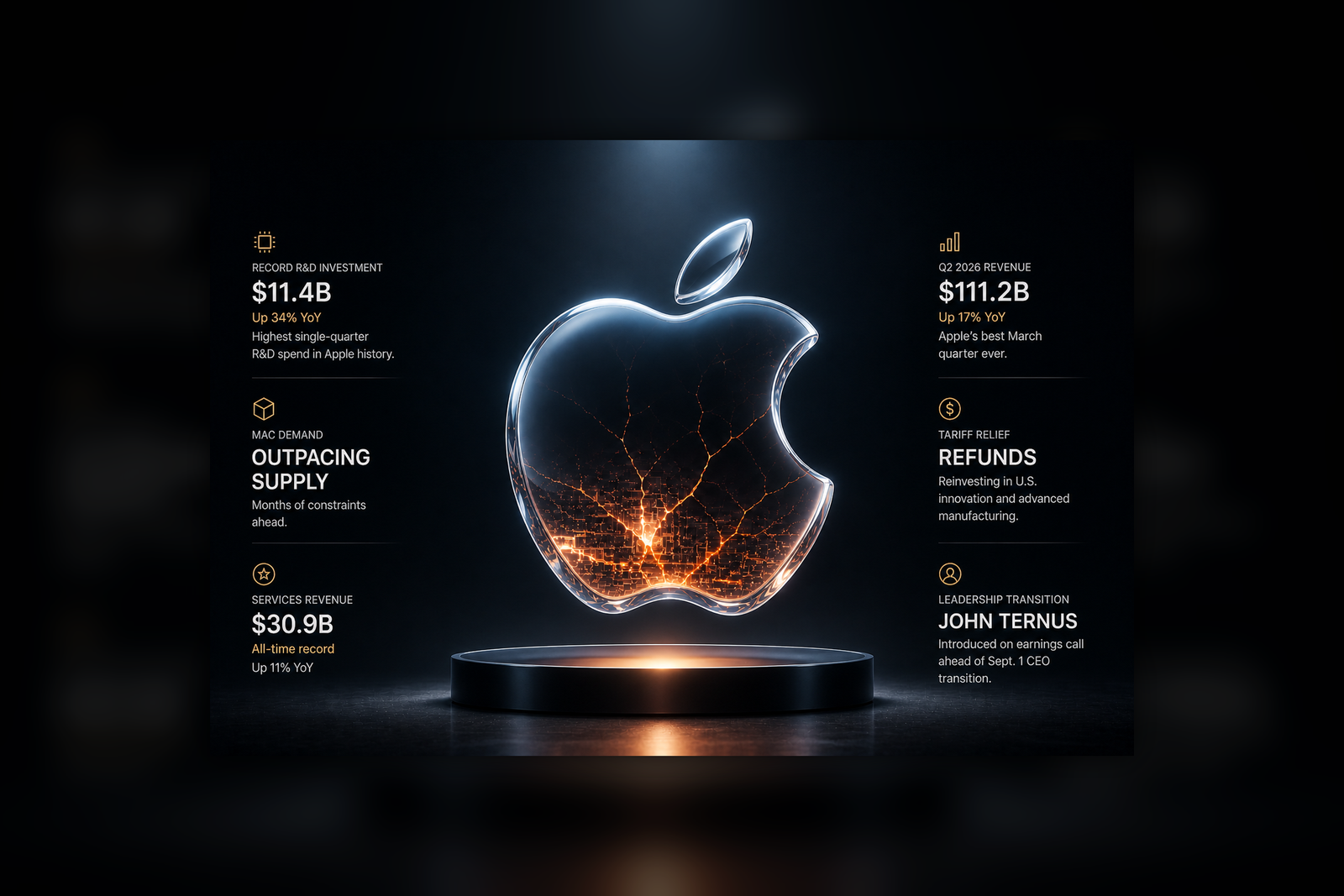
The headline numbers are unambiguously good. Apple reported $111.2 billion in revenue for its fiscal second quarter, up 17 percent year over year, beating Wall Street’s consensus estimate of roughly $109.7 billion. Earnings per share came in at $2.01, a 22 percent jump over the same period last year, clearing analyst expectations of $1.94. Services reached an all-time revenue record of $30.9 billion. iPhone revenue hit $56.99 billion, up from $46.84 billion a year ago, making it the most successful March quarter in the iPhone’s history. Tim Cook called it Apple’s “best March quarter ever,” and by the numbers, he’s right.
But embedded inside a quarter this strong are a handful of signals that complicate the picture: a record R&D spending figure that tells you exactly where Apple thinks the competitive pressure is coming from, a candid acknowledgment that the company misjudged demand for its AI-centric Mac hardware, tariff uncertainty that Apple is actively trying to monetize, and the first on-record appearance of incoming CEO John Ternus on an earnings call. Each of those threads matters more than the top-line beat.
The R&D Number Is the Real Story
Apple reported $11.4 billion in R&D expenses for the quarter, up 34 percent from Q2 2025 and the highest single-quarter R&D spend in company history. For context, Apple crossed the $10 billion quarterly R&D threshold for the first time only last quarter. The acceleration is not subtle.
When Bank of America analyst Wamsi Mohan pressed Cook on how Apple thinks about AI investment (specifically the build-versus-partner question), Cook’s answer was brief and pointed: “We are clearly investing more.” CFO Kevan Parekh added that AI is a “really important investment area” and that Apple intends to invest in it incrementally on top of its normal product roadmap, not as a replacement for it. That framing is significant. Apple isn’t redirecting existing R&D toward AI; it’s adding AI spend on top of the existing baseline.
Operating expenses rose 24 percent year over year, exceeding Apple’s own guidance partly due to a one-time SG&A item, but R&D was described as “accelerating much higher than the company overall.” That’s a notable admission on an earnings call. Companies don’t typically volunteer that a cost line is outrunning corporate growth unless they’re trying to signal conviction about where the investment is going.
Mac Demand Outran the Supply Chain
One of the more interesting moments in the earnings call came from Cook’s explanation of Mac supply constraints. Apple underestimated demand for the Mac mini and Mac Studio, both of which have become popular platforms for AI workloads and agentic tools. Cook acknowledged the gap directly: “Both of these are amazing platforms for AI and agentic tools and the customer recognition of that is happening faster than what we had predicted.”
The result is a supply chain that is months behind where demand is. Apple expects the Mac mini and Mac Studio imbalance to persist for several months into the June quarter, with “less flexibility in the supply chain” compounding the problem. Overall Mac revenue for the quarter was $8.4 billion, up from $7.3 billion a year ago, which means the supply constraint represented a ceiling on a category that was already growing. Apple is now relocating Mac mini production to its Houston advanced manufacturing center, which will eventually help, but not before this particular crunch works itself out.
The memory shortage is also playing a role here. Apple is navigating the same global RAM crunch that has hit every hardware company with serious AI ambitions. Cook noted the impact was “minimal” in December but “a bit more of a hit” in the March period, and he made no promises about it getting easier. That’s a meaningful signal heading into a fall iPhone cycle that will need to accommodate higher memory specifications at reasonable price points.
Tariffs, Refunds, and U.S. Manufacturing
Apple benefited from tariff relief during the quarter: reduced IEEPA rates and a lower global tariff under Section 122 softened the impact compared to what the company faced in Q1. But the tariff situation remains fluid, and Apple’s Q3 guidance of 14 to 17 percent year-over-year revenue growth comes with an explicit caveat that it assumes current tariff rates hold.
What Apple is doing in the meantime is worth noting. Cook confirmed that Apple is pursuing tariff refunds through the established regulatory process, and that any refunded amounts will be reinvested into U.S. innovation and advanced manufacturing, above and beyond the company’s existing $500 billion domestic investment commitment. It’s a carefully constructed message: Apple is following the rules, paying what it owes, seeking available relief, and cycling the proceeds back into American facilities. Whether that framing helps Apple with regulators or just makes for good earnings call optics, the underlying strategy of deepening U.S. manufacturing is real, and the Houston server facility is the most concrete current expression of it.
Ternus Makes His Introduction
The most consequential moment of the call may have been the briefest. Tim Cook introduced John Ternus, who spoke on an Apple earnings call for the first time ahead of his September 1 CEO transition. Ternus didn’t offer anything specific in terms of product or strategy direction: no announcements, no roadmap detail, no signal on the questions that analysts most want answered. What he offered instead was temperature: “While you’re not going to get me to talk about the details of that roadmap, suffice it to say, this is the most exciting time in my 25-year career at Apple.”
That’s the kind of language that is easy to dismiss as boilerplate, but context matters. Ternus has spent his Apple career as a hardware engineer and hardware executive. His enthusiasm about an unrevealed roadmap is coming from someone who built the things on that roadmap. The quarter’s Mac demand surprise, the record R&D spend, the acceleration of U.S. manufacturing capacity: all of that is infrastructure for something. What exactly is something Ternus will need to show, not just say. But his presence on the call, however brief, was a deliberate signal that the transition is already underway.
Cook characterized Ternus as “a brilliant engineer, a deep thinker, a person of remarkable character, and a born leader” and said there is “no one on this planet I trust more to lead Apple into the future.” That’s a high-profile handoff of credibility ahead of a CEO change that, by any measure, is one of the most significant in the company’s history.
What the Quarter Actually Reveals
Strip away the record-setting language and the Q2 2026 earnings call is a story about Apple accelerating into AI with real money, managing supply chain realities in a memory-constrained environment, positioning itself carefully in a tariff-defined trade landscape, and beginning the formal introduction of its next leader.
The $30.9 billion in Services revenue matters because it’s Apple’s most structurally resilient business. The $100 billion buyback authorization and 4 percent dividend increase matter because they signal confidence in near-term cash generation. The 22 percent iPhone revenue growth matters because it suggests the iPhone 17 lineup drove genuine demand, not just upgrade-cycle mechanics.
But the $11.4 billion R&D quarter, the Houston production move, and the Mac demand surprise all point in the same direction: Apple is building toward something larger, spending ahead of it, and betting that AI demand at the hardware and services layer will justify the investment. The June quarter guidance assumes nothing gets worse on tariffs, the memory situation doesn’t improve quickly, and the new CEO takes the stage in September with a product lineup that, if Ternus is right, he has reason to be excited about.

![Everything New in Apple's 26.5 Betas: RCS Encryption, Maps Changes, [Update - Beta 4]](/content/images/size/w800/2026/04/ChatGPT-Image-Apr-27--2026-at-12_09_56-PM-1.png)


