
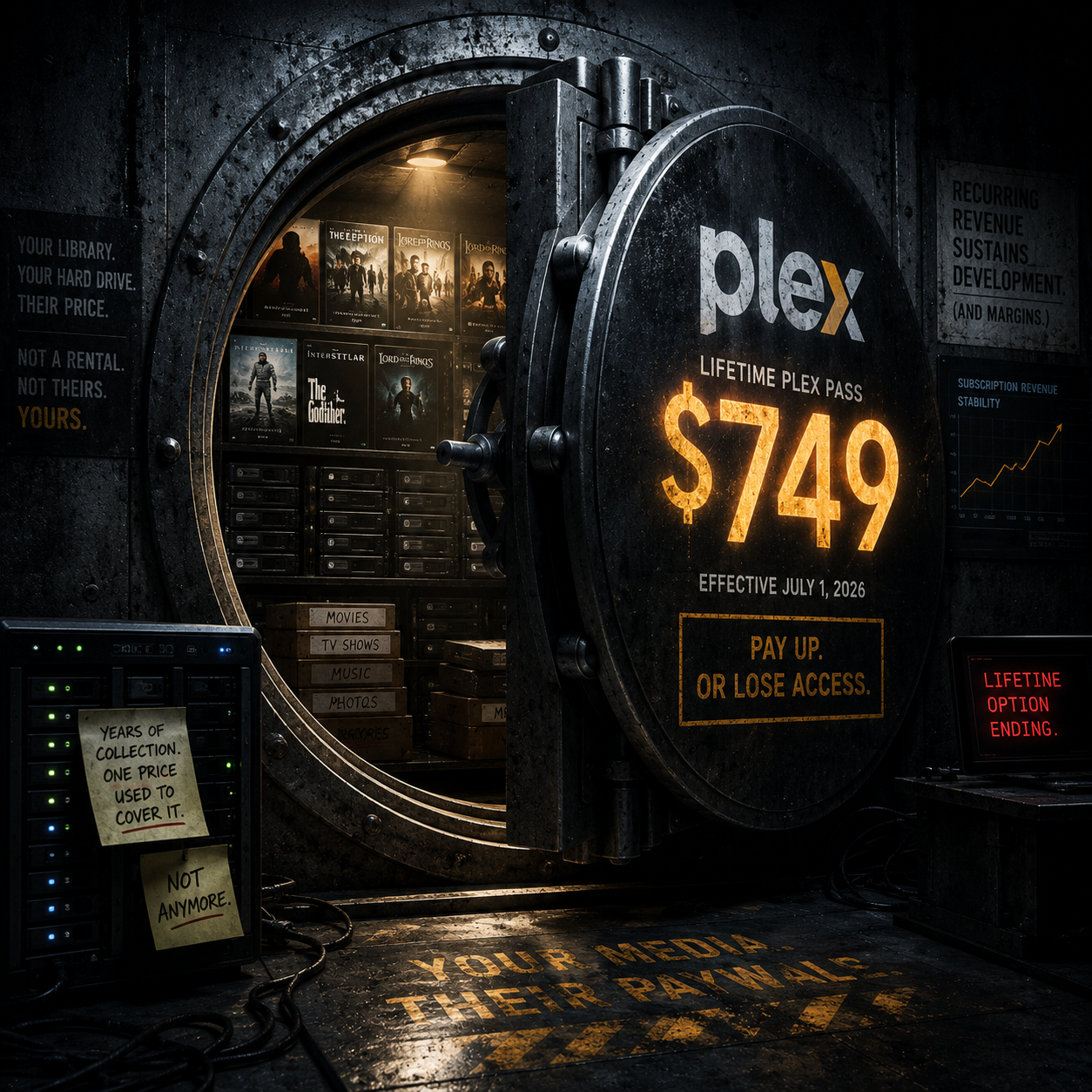
Plex has announced it will raise the price of a Lifetime Plex Pass from $249.99 to $749.99 on July 1, 2026. That's a $500 jump, effective in about six weeks. It's also the second major increase in just over a year: Plex doubled the lifetime price from $119.99 to $249.99 in April 2025. In the span of roughly fourteen months, the cost of buying Plex outright has gone from $120 to $750.
The company's framing is predictable. The new price "reflects the real, ongoing value of the software we're committed to building and maintaining for years to come." But Plex also did something unusually candid in the same announcement: it admitted it has considered eliminating the Lifetime Pass entirely, citing the stability of recurring subscriptions. That admission is the actual story here. The $750 price tag isn't a recalibration. It's a designed deterrent dressed up as a premium option.
What Plex Pass Actually Gets You
Before unpacking the strategy, the basics matter. Plex is media server software that lets you organize your personal library of movies, TV shows, music, and photos, then stream it to virtually any device. The free version covers the core functionality well enough, but Plex Pass unlocks the features that serious users actually want.
Hardware transcoding sits at the top of that list. Without it, your server does software transcoding for every stream that can't be played natively by the client device, which hammers CPU performance and limits how many simultaneous streams you can run. Plex Pass turns on GPU-accelerated transcoding, which is the difference between a capable server and one that chokes when two people are watching at once.
Beyond that, Plex Pass includes offline sync for mobile devices, live TV and DVR functionality (paired with a tuner), access to Plexamp (their dedicated music player, which is genuinely excellent), server stats via Plex Dash, multi-user sharing with granular controls, and features like "Skip Intro" and chapter images. For anyone running a proper home media setup, most of these aren't nice-to-haves.
Monthly Plex Pass runs $7. Annual is $70. Those prices haven't changed with this announcement, and Plex was explicit that existing Lifetime holders keep everything they have.
The Math That Makes $750 Untenable
At $7 per month, a Lifetime Pass at $250 broke even in roughly three years. That's a reasonable proposition for anyone who plans to use Plex long-term, and the Plex community skews heavily toward exactly those users.
At $750, break-even jumps to just under nine years. That's a very different bet. Nine years is a long time to wager on any software platform remaining relevant, the company remaining solvent, and your own media habits staying constant. Plex itself only launched in 2009. Asking someone to front nine years of subscription value assumes a level of confidence in the platform's longevity that the company's own pricing trajectory quietly undermines.
The annual option at $70 breaks even in about ten and a half years. The lifetime price is now within months of parity with just paying annually indefinitely, which removes virtually all financial incentive to buy lifetime at all.
That math isn't accidental.
Manufactured Urgency, Then a Soft Redirect
The announcement pairs the price increase with a countdown: buy before July 1 at $249.99 or face the new rate. This is a classic urgency mechanism, and it will work. A significant wave of users who were on the fence will lock in the lifetime option before the deadline, generating a short-term revenue spike.
But Plex's long-term goal is clearly the opposite. The company said it openly: recurring subscriptions sustain long-term development in a way one-time payments don't. A user who paid $120 for a lifetime pass in 2018 and is still actively using Plex in 2026 has generated exactly $120 in revenue over eight years. A monthly subscriber over the same period has generated around $672. The unit economics of a lifetime pass get worse for Plex every year a user keeps using it.
Pricing the lifetime option at a level that only the most committed power users would pay effectively converts the option from a mainstream choice to a niche one. Most casual or moderate users will look at $750 and move to the $70/year plan, which is exactly the outcome Plex is designing for.
The Jellyfin Question
Any honest conversation about this pricing shift has to acknowledge what it does to Plex's competitive position with Jellyfin, the open-source, fully free alternative that has grown meaningfully in the last few years.
Jellyfin doesn't have a paid tier at all. It supports hardware transcoding, mobile playback, multi-user setups, and most of the features Plex Pass unlocks, with the tradeoff being a rougher setup experience and a less polished client ecosystem. For technically capable users, that tradeoff has been acceptable for a while. At $750, it just got a lot more acceptable for a broader audience.
Plex has always competed on polish and the convenience of its client apps, which genuinely are better than Jellyfin's across most platforms. That advantage is worth something. Whether it's worth $750 upfront is a different question, and Plex is implicitly betting that most of the users who would consider Jellyfin have already made that switch. The remaining Plex base, in their model, is sticky enough to convert to monthly or annual without defecting.
That may be right. But aggressive lifetime pricing has historically been one of Plex's primary acquisition tools: someone pays once, becomes deeply invested in their library organization and setup, and never leaves. Removing that on-ramp doesn't just change revenue mix. It changes who shows up to begin the Plex relationship in the first place.
Reading the Roadmap
Alongside the pricing announcement, Plex published a feature roadmap. The list includes download improvements with show grouping, playlist editing in mobile apps, restoration of music and photo library support in mobile, NFO metadata support, server management features across apps, audio enhancements, transcoding improvements, and IPv6 support.
It's a reasonable list, and most of the items address genuine long-standing gaps. But it reads like a list compiled in response to community frustration, not a list that justifies tripling the lifetime price. Several items, restoring music and photo library support in mobile apps, for instance, are regressions being corrected rather than new value being added. Plex quietly removed those features in a previous update cycle, and their return isn't an expansion of what Plex Pass offers. It's a restoration of what it used to include.
The roadmap is real, but it's doing a lot of rhetorical work in this announcement that the substance doesn't fully support.
What This Actually Is
Plex is a profitable, mature product with a loyal user base that skews toward people who care deeply about owning and controlling their own media. That user base has historically been willing to pay a premium for the convenience and polish Plex provides, precisely because the alternative is ceding that control to streaming services.
The lifetime price increase is Plex choosing to extract recurring revenue from that loyalty rather than reward it. The company isn't wrong that recurring subscriptions are more sustainable. They're also not wrong that the old $120 lifetime price was probably underpriced for what Plex has become.
But going from $120 to $750 in fourteen months, while simultaneously publishing a roadmap that partially consists of fixing things you broke, signals something about how Plex views the relationship with its core community. Power users, the ones who run Plex servers with 10,000-item libraries and multiple simultaneous streams, have always been the platform's most vocal advocates. They recommended Plex to friends, wrote setup guides, filed bug reports, and made the community forums worth visiting.
Pricing the lifetime option out of reach for most of them doesn't eliminate that community. But it does stop treating them as the constituency the product is built for.
At $750, the Lifetime Plex Pass still exists. Whether it still makes sense depends entirely on how much you trust that Plex will look similar in 2035 to what it looks like today. Given that the company just tripled its entry price in just over a year, that's not a trivial assumption to make.