
There is a version of today's Fitbit Air announcement that reads as a straightforward product launch: a $99.99 screenless fitness tracker with solid specs, a clean design, and a reasonable entry point for anyone priced out of the Pixel Watch. That version is not wrong, exactly. It just misses what Google actually did today.
The Fitbit Air is a good product. It is also the hardware peg Google needed to complete a years-long, methodical erasure of the Fitbit software identity. The tracker ships May 26. The Fitbit app stops being the Fitbit app on May 19. The sequencing is not accidental.
What the Fitbit Air Actually Is
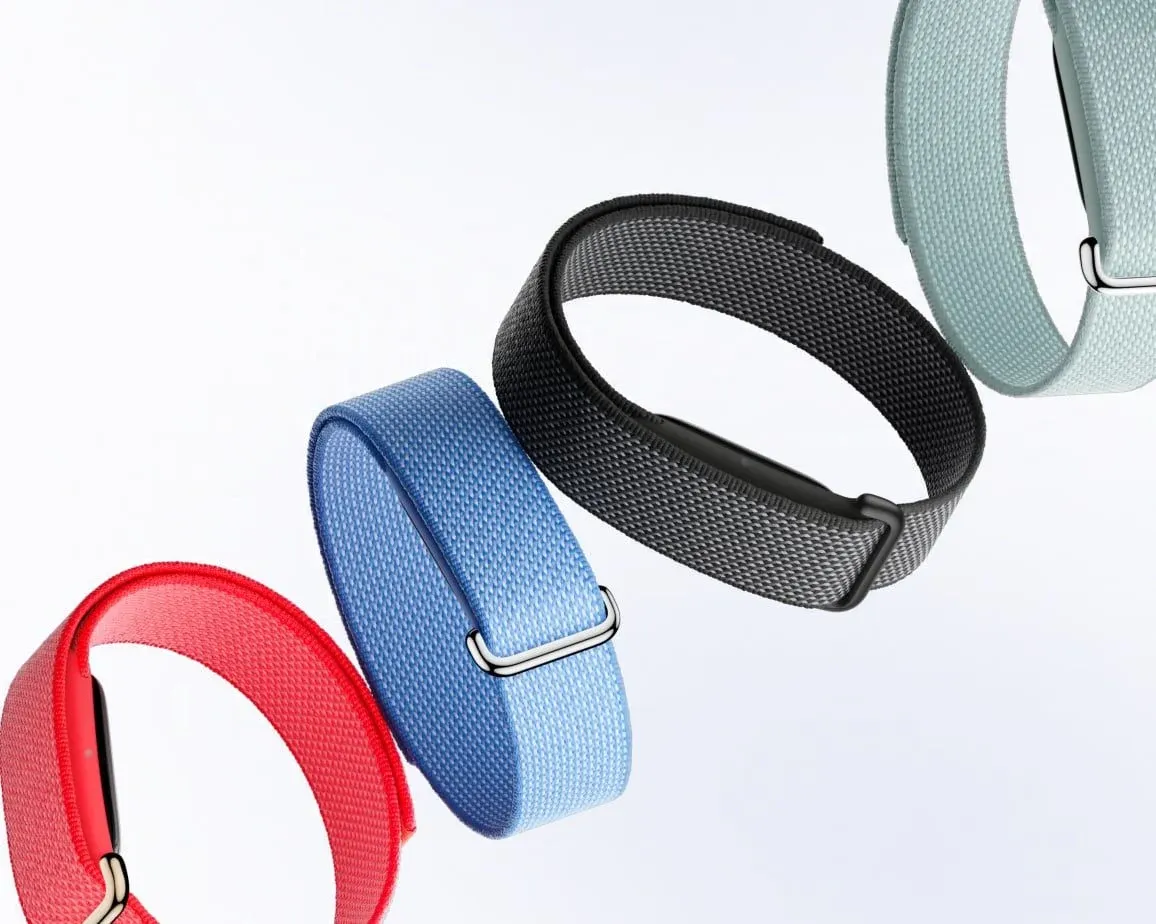
Start with the hardware, because it is genuinely interesting on its own terms. The Fitbit Air is a screenless pebble-shaped tracker that weighs 5.2 grams on its own and 12 grams with the included Performance Loop band. It clips into and out of the band mechanism from below, which means swapping bands does not require tools or patience. The entire unit is water-resistant to 50 meters.
The sensor array is more substantial than the price suggests: an optical heart rate monitor, a 3-axis accelerometer and gyroscope, red and infrared sensors for SpO2 monitoring, and a device temperature sensor for skin temperature variation. That hardware stack supports 24/7 heart rate tracking, AFib irregular heart rhythm notifications, heart rate variability, cardio load, sleep stages and duration, and automatic activity detection. You can also start workouts manually from your phone or log them after the fact in the Google Health app.
What you do not get is a screen. There are no on-device notifications, no glanceable stats, no display of any kind. The only feedback the device offers is a vibration motor, used for the Smart Wake alarm and low-battery alerts, and a red status light for battery warnings. That is the point. Google is explicitly targeting people who find smartwatches too distracting, too bulky, or too expensive. The Fitbit Air is designed to be forgotten on the wrist.
Battery life is rated at seven days, with quick charging that provides a full day of use in five minutes and a full charge in 90 minutes. The magnetic charger is bidirectional and uses USB-C, which is a welcome upgrade. The unit ships with the Performance Loop band; Google also offers an Active Sport silicone band separately, both at $34.99.
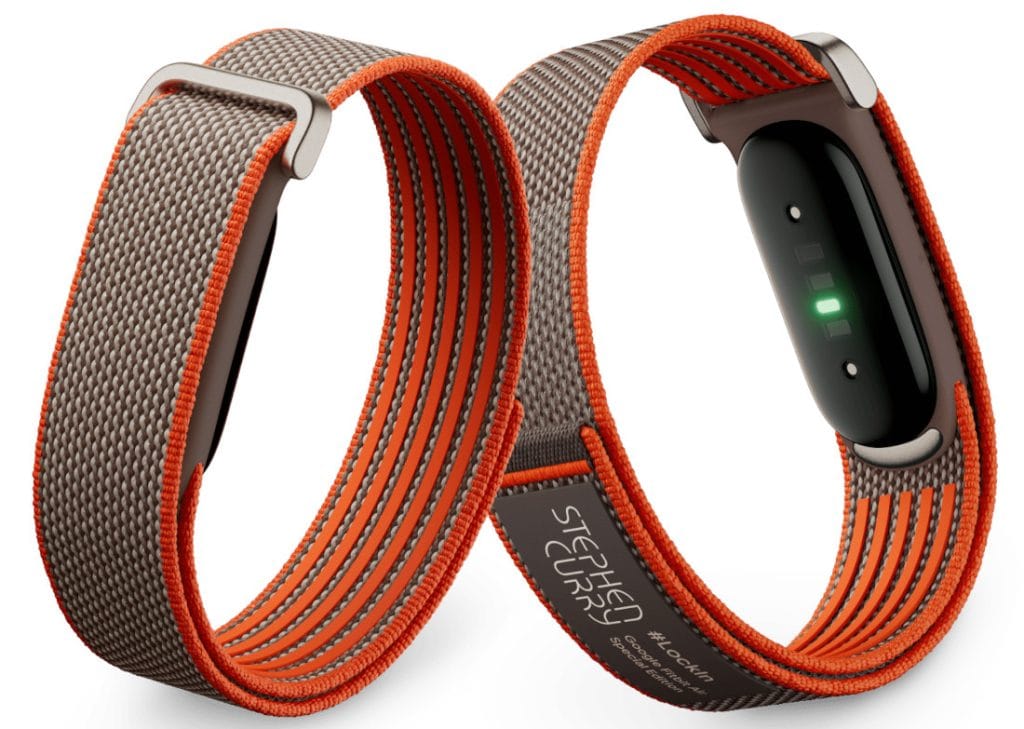
Pre-orders opened today. The device ships May 26 in the US and 20 additional countries, starting at $99.99. A Stephen Curry Special Edition runs $129 and includes a co-designed Performance Loop band with a water-resistant coating and raised interior print. Every purchase includes three months of Google Health Premium.
The Category Google Is Trying to Own
The Fitbit Air is not a device aimed at a specific competitor. It is an argument for a form factor. Screenless, passive trackers have existed on the fringe of the wearables market for years, appealing to a narrow segment of users who found smartwatches too distracting and fitness bands too basic. Google is betting that fringe is actually a mainstream preference that just never had a well-marketed, broadly available product to attach to.
The pitch is structural: most people who do not wear a wearable today are not avoiding them because of price alone. They are avoiding the notification burden, the charging anxiety, and the self-consciousness of a device that announces itself on the wrist. A 12-gram pebble with a seven-day battery and no screen removes all three objections at once. At $99.99, it also removes the fourth.
What Google brings to that form factor that no one else has is platform scale. The Fitbit Air feeds into Google Health, which is the company's attempt to build something much larger: a unified health data platform that aggregates wearable data from Pixel Watch, Health Connect-compatible devices, Apple Health on iOS, and medical records in the US. The device is a data collection node as much as it is a consumer product. More wrists wearing Fitbit Air means more data flowing into Google Health, which makes the Gemini-powered Health Coach more useful, which makes the Premium subscription easier to justify. The hardware economics at $99.99 make sense precisely because that is not where Google intends to make money long-term.
The device also supports simultaneous use with a Pixel Watch, with Google Health automatically handling the handoff between the two. The explicit use case: wear the Pixel Watch during the day for screen access, switch to the lighter Fitbit Air at night for sleep tracking. That is a shot across Samsung's bow. The Galaxy Watch and Galaxy Ring do not work together in the same way, which Google leaned into in its announcement materials.
The Rebrand Is the Real Announcement
The Fitbit Air is a solid $99 wearable. The Google Health rebrand is a decade of strategic positioning finally made explicit.
Google acquired Fitbit in 2021 for roughly $2.1 billion. Since then, it has methodically transferred the brand's equity into Google's infrastructure: Fitbit accounts merged into Google accounts, the web dashboard shut down, the Fitbit app shipped as the default health app on select Android devices, and Google Fit's APIs closed to new developers in 2024. All of that was groundwork. Today is the structure going up on top of it.
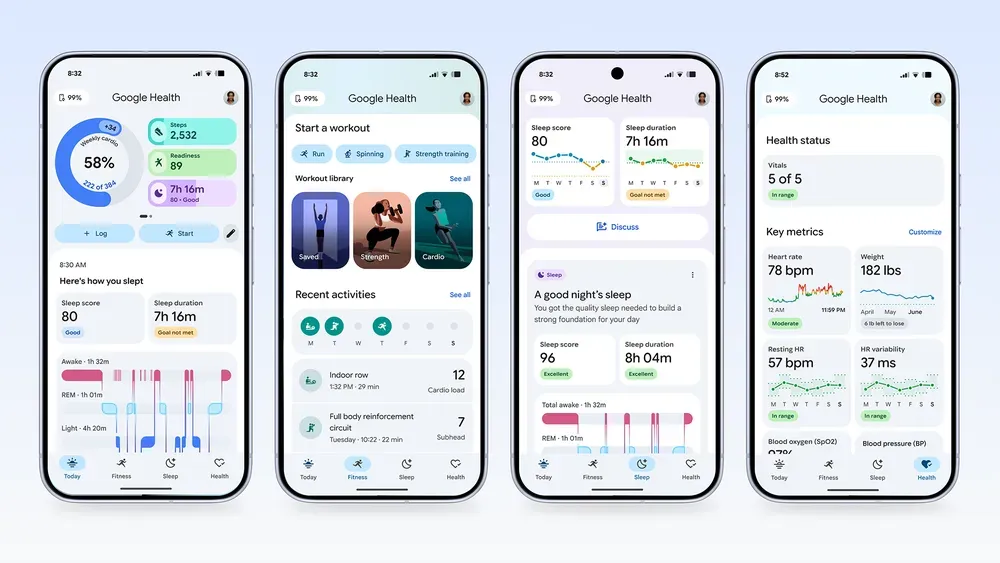
Starting May 19, the Fitbit app will update automatically to Google Health for existing users. No migration required, no data loss. The four-tab layout (Today, Fitness, Sleep, and Health) replaces the existing interface, with customizable dashboards surfacing the metrics users actually track. Fitbit Premium becomes Google Health Premium, priced at $9.99 per month or $99.99 annually. The annual price increased from $79.99 under Fitbit, a detail easy to miss in the announcement noise. Google Health Premium is also included in Google AI Pro and AI Ultra subscriptions in 30-plus countries.
The Google Health Coach, a Gemini-powered AI assistant that has been in public preview since October, exits preview with this launch and goes global. The Coach supports conversational health queries, adaptive fitness plans, sleep analysis, and, for Premium subscribers, medical record summarization. A new multimodal logging feature lets users log food via text, voice, or photo with automatic recognition.
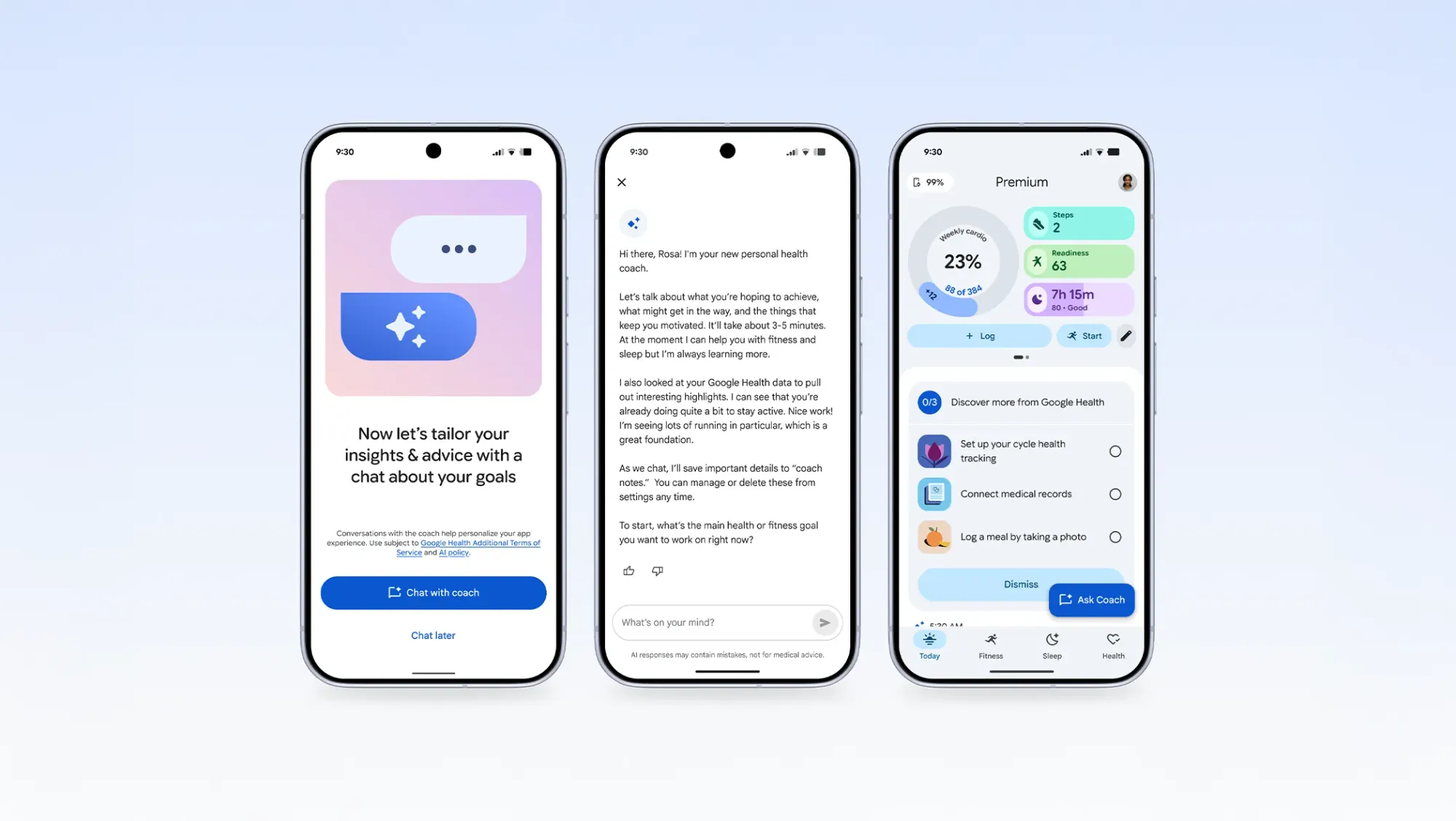
Google Fit, the original Android fitness tracking app launched in 2014, gets a migration path to Google Health later this year and a shutdown date before the end of 2026. That is the last piece of the old architecture being retired. When Fit users migrate, Google will have consolidated its entire health and fitness software presence under a single platform for the first time.
What the Brand Transition Means
The Fitbit name does not disappear with today's announcement. Google has been careful to say the brand "continues to be at the heart of our hardware." The device is called the Google Fitbit Air, not just the Fitbit Air or the Google Air. That framing is deliberate: Fitbit survives as a hardware sub-brand, similar to how Pixel functions within Google's device portfolio.
But the software, the service layer, and the premium subscription are now Google's outright. The platform where your health data lives, the AI that interprets it, and the subscription that unlocks full access are all Google products now, with Fitbit branding present only on the physical device in the box.
That is a meaningful distinction. Fitbit's original value proposition was the totality of the ecosystem: hardware, app, community, and coaching together. Google has essentially split that in two, keeping the hardware identity and absorbing everything else. Whether the Fitbit brand name provides enough recognition to justify keeping it on hardware long-term, or whether it eventually becomes a legacy footnote the way Motorola did after Google's acquisition and subsequent sale, is a question worth watching.
For users, the transition is mostly positive in the near term. A unified health platform that pulls from wearables, Health Connect, Apple Health, and medical records is genuinely more useful than a siloed Fitbit app. The Google Health Coach has more capability than Fitbit's previous AI features, and the Gemini integration has real potential for personalized health insights beyond what static metrics dashboards provide.
The friction will come later, as it always does when Google consolidates platforms. The annual subscription price increase from $79.99 to $99.99 is the first signal. The eventual deprecation timelines for features that do not fit the new architecture will be the next.
Google has quietly published a full list of features that do not survive the transition. Sleep Profiles and the monthly sleep animal system are gone, replaced by a prompt to ask the Health Coach what kind of sleeper you are. Snore Detection on the Sense and Versa 3 is being removed. Estimated Oxygen Variation disappears. The Stress score becomes "Resilience," a simplified three-tier label. Minute-by-minute skin temperature data is replaced by daily and weekly trends only. Badges, both new and previously earned, are being retired entirely. Direct messages, Groups, and the Community Feed are all shut down. Blood glucose tracking loses symptom logging and level reminders. Food Plans are removed. Premium recipes are gone.
Anyone who has watched Google's product consolidation history knows that the migration tool is not the end of the story.
For now, the Fitbit Air is a well-priced entry into a category Google has clearly decided to take seriously. At $99.99, it removes the cost barrier that kept casual users in pedometer territory, and the three months of Google Health Premium bundled with every purchase is Google's clearest possible signal about what it actually wants you to pay for long-term.
The hardware got the headline. The rebrand got the future.