

There is a version of the Rivian story that ends badly. The company goes public at a $66 billion valuation in 2021 with almost no revenue, burns through billions building two premium vehicles aimed at adventure-seeking affluents, watches its stock crater, and quietly fades out as another EV cautionary tale. That story is still possible. But on April 22, 2026, Rivian CEO RJ Scaringe drove the first customer-ready R2 off the assembly line at the Normal, Illinois plant, and the company bought itself a very different kind of future.
The R2 is not just a new model. It is the entire thesis Rivian has been arguing for years: that the company can build affordable, mass-market electric vehicles, reach profitability, and survive long enough to become something durable. The R2 start of production is the most consequential moment in Rivian’s history. It is also, in a very specific sense, the moment where excuses run out.
The Long Road to Normal, Illinois
Rivian first sketched out the R2 platform in 2022, with an initial target of launching in 2025. That timeline slipped. Early planning had the R2 built at a new dedicated factory in Georgia, a facility that would eventually handle hundreds of thousands of units per year. In March 2024, at a splashy event in Laguna Beach, California, Scaringe revealed the production R2 design alongside two surprise concepts, the R3 and R3X, and announced a pivot that changed everything: R2 production would begin at Rivian’s existing Normal plant, not in Georgia.
That decision saved approximately $2.25 billion and pulled the production timeline forward. It also meant threading a very complicated needle: converting a plant already producing R1 trucks, R1S SUVs, and commercial delivery vans to accommodate an entirely new platform with different architecture, new battery chemistry, and dramatically different manufacturing processes. In September 2025, Rivian shut the Normal plant down for roughly three weeks to integrate the manufacturing changes required before R2 production could begin. By January 2026, the first validation units were rolling off the line.
Then, five days before production start, an EF-1 tornado tore through McLean County and struck Building 2 directly. Building 2 is the R2 production area. The storm collapsed a section of the roof and damaged walls. No employees were injured, and Rivian paused operations to assess the damage. Scaringe appeared on Bloomberg Television days later to confirm the company expected no delays.
He was right. Production began as scheduled.
The speed of recovery from a literal act of nature says something about where Rivian’s operational discipline stands heading into this launch. It is not the chaotic startup of 2021.
What the R2 Actually Is
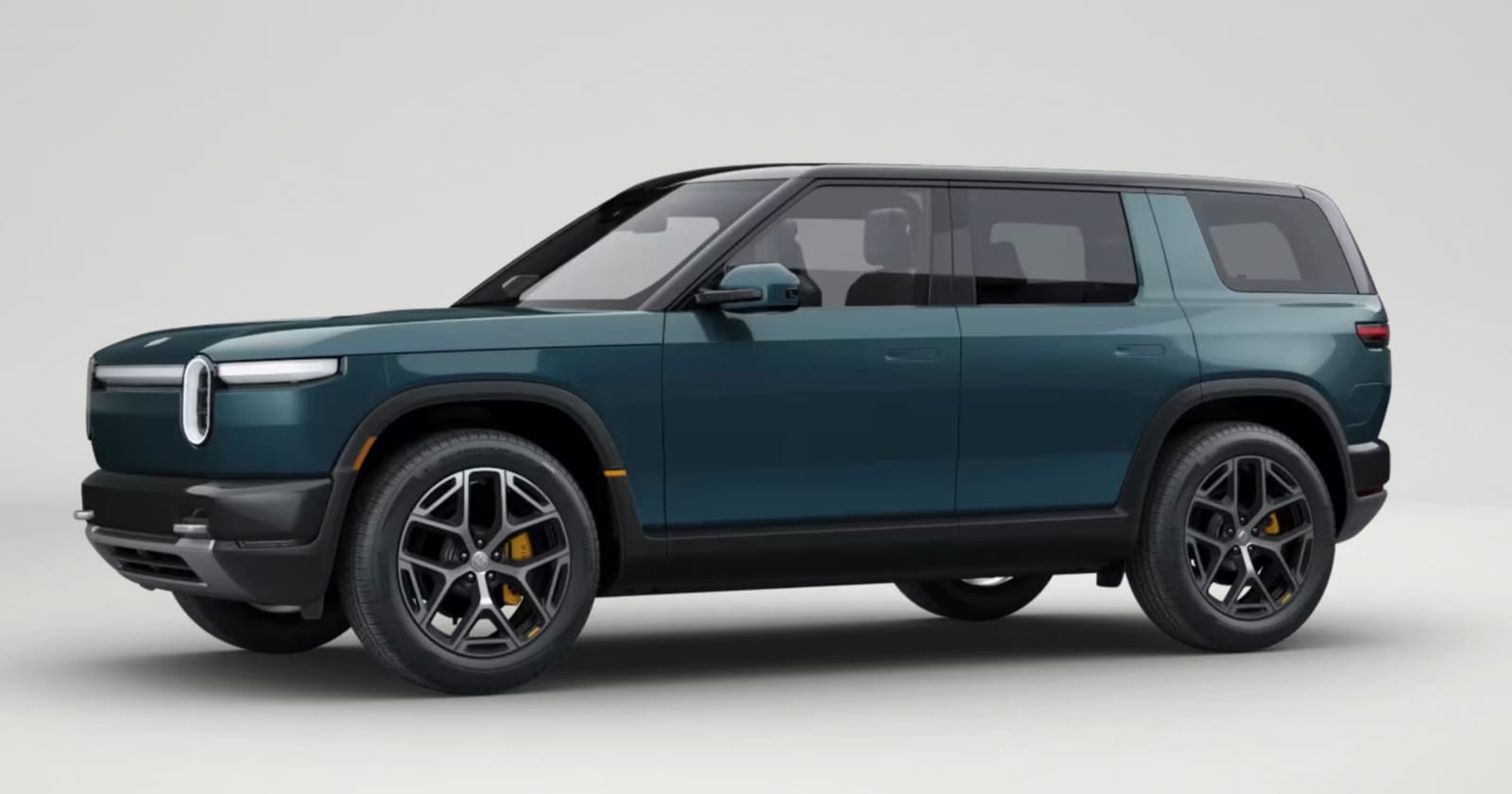
The R2 is a two-row, five-passenger midsize electric SUV, and it looks exactly like you would expect a Rivian to look: slab-sided, boxy, practical, with the same oval headlights that make R1 vehicles recognizable from a block away. At 185.9 inches in length, it is a full two and a half feet shorter than the R1S, rides on a 115.9-inch wheelbase, and comes in nearly 2,000 pounds lighter than its R1 stablemates. Ground clearance checks in at 9.6 inches.
The platform represents a genuine engineering rethink, not a shrink job. The 2024 reveal prototype was essentially a reskinned R1S riding on R1 architecture. The production R2 is something different: a purpose-built vehicle with new battery chemistry using LG Energy Solution 4695 cylindrical cells (larger format, higher energy density than the R1’s 2170 cells), a new drive unit architecture, and structural manufacturing changes that Rivian credits with dramatic cost reductions. Die casting reduces manufacturing costs by 32%. The new drive unit cuts 25%. A simplified suspension design slashes costs by 72%. At the production volumes Rivian expects in 2027, the company says the R2 will cost less than half as much to build as the current R1.
The first trim hitting production is the Performance Launch Edition at $57,990. The spec sheet is genuinely impressive: 656 horsepower from a dual-motor AWD setup, 87.9 kWh battery, 330 miles of EPA-estimated range, 3.6-second zero to 60, and 4,400 pounds of towing capacity. It out-ranges the Tesla Model Y Performance (306 miles) while achieving 109 MPGe combined versus the Model Y’s 104 MPGe, in a heavier and boxier package. For buyers cross-shopping at this price point, the R2 Performance is a legitimate competitor.
The full trim lineup and the uncomfortable pricing reality behind it looks like this:
- Performance AWD (Launch Edition): $57,990, available spring 2026
- Premium AWD: $53,990, late 2026
- Standard Long Range RWD: $48,490, early 2027
- Standard RWD: approximately $45,000, late 2027
Inside, the Performance Launch Edition includes 21-inch Liquid Tungsten wheels, Dynamic Adventure lighting with matrix LEDs and adaptive high-beams, 12-way power adjustable heated and ventilated front seats, heated rear seats, a 9-speaker 975-watt premium audio system, rear drop glass, and integrated tow hooks. The Launch Package specifically adds lifetime access to Rivian’s Autonomy+ driver-assistance suite, exclusive Launch Green paint, and a Black Crater Signature interior with upcycled birch wood trim.
On the technology side, the R2 ships with 11 HDR cameras and a five-radar system. Autonomy+ delivers Level 2-plus hands-free assisted driving across 3.5 million miles of mapped U.S. roads, available as a $2,500 one-time purchase or $49.99 per month for buyers outside the Launch Package. Later in 2026, Rivian plans to begin shipping R2s equipped with lidar and its proprietary RAP1 chip, a 5nm processor designed in-house that the company says will eventually enable Level 4 autonomous capability. The R2 also comes with a NACS charging port natively, a first for an all-new Rivian platform.
One notable omission: the launch trim ships without a heat pump, relying on a conventional air conditioning system instead. Rivian has indicated future trims may add one, but buyers in cold climates should be aware that range penalties in winter will be more pronounced than on competing EVs that already include heat pump systems by default.
The $45,000 Elephant in the Room
Rivian has been marketing the R2 as a $45,000 vehicle since March 2024. That number is still technically accurate. It is also the price for a configuration that will not exist until late 2027, and by that point the automotive landscape will look considerably different.
The gap between the advertised entry price and the actual launch price is not trivial. Buyers who reserved an R2 two years ago on a $100 refundable deposit with a $45,000 vehicle in their heads will be presented with a $57,990 option first. The $7,500 federal EV tax credit has been eliminated. Legacy automakers have stopped purchasing regulatory credits from companies like Rivian, closing off another financial cushion. Import tariffs have increased component costs. The $45,000 base model arrives last, and will top out at approximately 275 miles of range, well below the 330 miles the launch trims offer.
Rivian’s stated rationale for leading with the high-spec trim follows standard automotive practice: launch with the most profitable configuration first, capture early-adopter enthusiasm, and use that margin to fund the ramp toward volume. The company told TechCrunch it wanted early owners to experience the peak of the platform before the lineup expanded. That logic is defensible in isolation.
The problem is context. Rivian built its brand on the promise of adventure vehicles for regular people, not just those with $58,000 to spend. The reservation holders waiting since 2024 were not mostly cross-shopping with Tesla Model Y Performance buyers. The delay to the accessible price point, compounded by the removal of the federal credit, will convert some percentage of reservation holders into people who buy a Model Y or a Hyundai Ioniq 5 instead.
CFO Claire McDonough acknowledged at production start that meaningful R2 volume should not be expected until the second half of the year. The production ramp is ambitious: analysts at BNP Paribas estimate fewer than 400 R2 deliveries in Q2, approximately 7,000 in Q3, and around 15,000 in Q4. Rivian has projected 20,000 to 25,000 total R2 deliveries by end of 2026. If that holds, it would rank among the fastest EV launch ramps in U.S. history.
What This Means for Rivian’s Survival
The arithmetic of Rivian’s survival has always been straightforward. The R1 vehicles are brilliant and expensive and appeal to a narrow audience. Commercial delivery vans for Amazon provide revenue but don’t tell the mass-market story. Without a vehicle that scales, profitability was an abstract concept.
The R2 plant at Normal currently has capacity for 155,000 R2s annually. Rivian is upgrading total plant capacity from 150,000 to 215,000 vehicles per year. The Georgia factory, paused when the production decision shifted to Normal, is expected to begin partial operations in 2027 and become the primary R2 hub as volume grows into the hundreds of thousands. The company targets positive automotive gross margins by end of 2026, though the initial ramp will pressure margins before the cost reductions embedded in the platform begin paying out at scale.
Beyond straight vehicle sales, Rivian has added a strategic layer through an Uber partnership valued at up to $1.25 billion, centered on a robotaxi initiative built around the R2 platform. That deal extends the platform’s commercial utility past the consumer market and provides another profitability pathway if Rivian’s autonomy development keeps pace.
Q1 2026 deliveries of 10,365 vehicles were entirely R1s and commercial vans. Full-year guidance of 62,000 to 67,000 total deliveries means the R2 has to contribute materially in the second half. The April 30 earnings call will be where the real details surface.
The Tornado and the Timeline
There is something almost symbolic about how this production launch unfolded. Rivian has spent years navigating delays, pivots, funding crunches, market headwinds, and an EV industry that has been considerably less triumphant than the 2021 hype cycle suggested. A tornado knocking the roof off the R2 production building five days before start of production is, in some ways, a fitting capstone to a development saga full of setbacks.
That Rivian fixed it in five days and launched on schedule is the more important story.
The R2 is a real vehicle with genuinely competitive specs, a thoughtfully engineered platform, and a cost structure that, if the numbers hold, could finally deliver the unit economics Rivian needs. The pricing is higher than customers were led to expect, the base model is years away, and the production ramp will test every supply chain relationship Rivian has built. None of that is a reason to dismiss what happened on April 22.
For the first time, Rivian has the vehicle it always said it would build. Whether that is enough depends entirely on what comes next.