
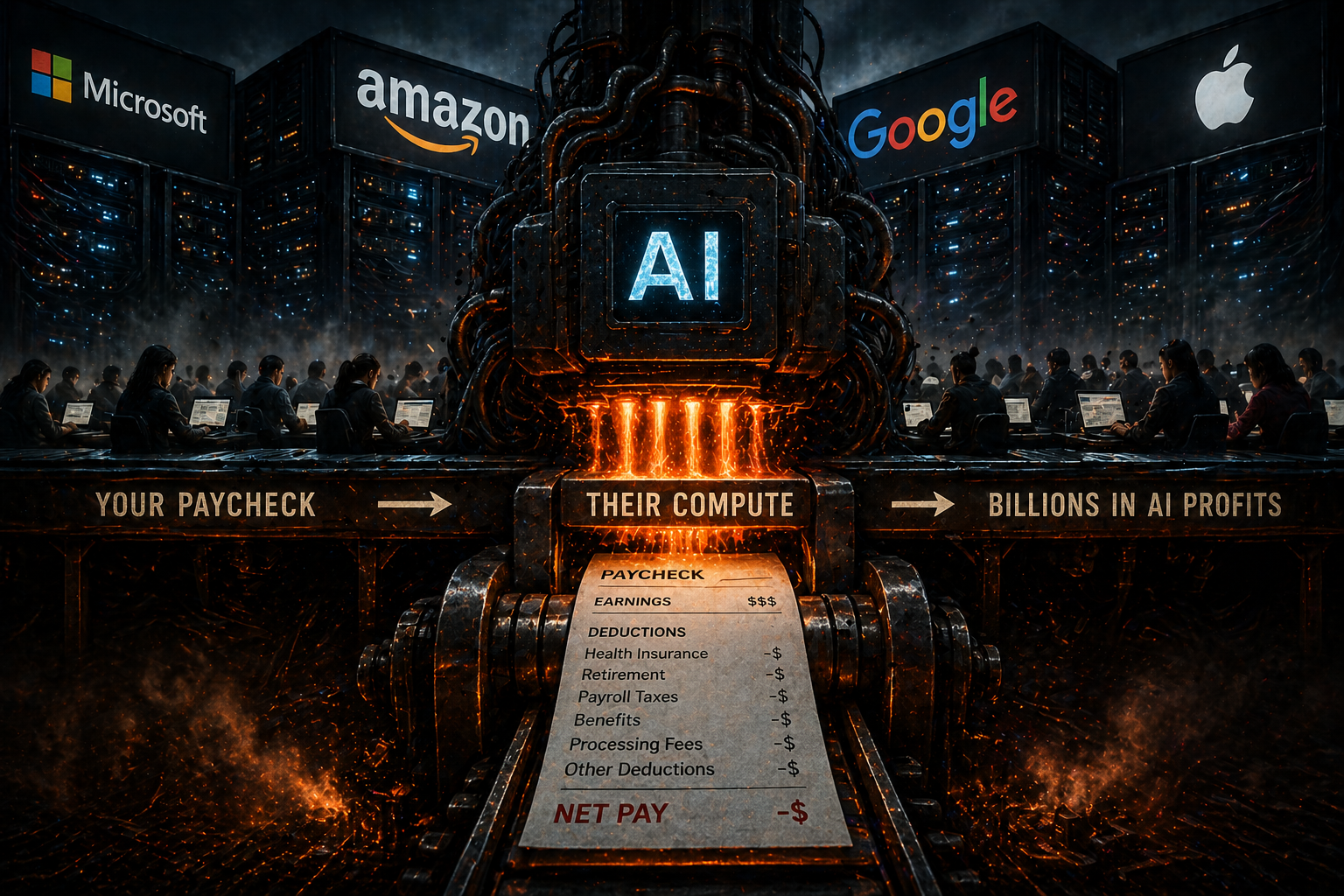
Meta and Microsoft cut a combined 23,000 jobs last week. Both reported record revenues. Both are redirecting the savings into AI infrastructure worth hundreds of billions of dollars. The timing is not coincidental. The framing matters.
The language these companies used is worth sitting with. Meta's chief people officer, Janelle Gale, wrote in an internal memo that the cuts were "part of our continued effort to run the company more efficiently and to allow us to offset the other investments we're making." Those other investments are $115 to $135 billion in 2026 capital expenditure, directed almost entirely at data centers, Nvidia GPUs, custom silicon, and AI infrastructure. That's nearly double what Meta spent in 2025. Meta's full-year 2025 net income was $22.8 billion in the fourth quarter alone. The company is not cutting because it cannot afford its workforce. It is cutting because it would rather spend the money on machines.
Microsoft took a different path to the same destination. Rather than involuntary layoffs, it offered voluntary buyouts to roughly 7% of its US workforce — approximately 8,750 employees — with eligibility determined by combined age and years of service. The method is gentler. The logic is the same. Microsoft's GitHub Copilot now writes close to 40% of code in repositories where it's deployed. Azure cloud operations have seen automated infrastructure management reduce manual intervention requirements significantly. The roles being bought out are, as a pattern, the ones AI has made structurably redundant.
What makes this wave different from the ones that came before it is that the companies are no longer looking for cover stories. In 2022 and 2023, mass layoffs were attributed to pandemic-era overhiring. In 2024 and 2025, the framing was restructuring around AI. In 2026, Meta and Microsoft stated the connection explicitly. Oracle said it was cutting jobs to build AI data centers. Meta said the cuts would offset its AI investments. Microsoft structured its buyout to select against employees least aligned with its AI future. No one is pretending anymore.
The Numbers Behind the Shift
Over 92,000 tech workers have been laid off so far in 2026, according to Layoffs.fyi, bringing the total to nearly 900,000 since 2020. Amazon has cut at least 30,000 jobs since October alone, representing about 10% of its corporate and technology workforce. Google has conducted small but regular cuts throughout the year. Nike's technology department took a significant hit last week. The scale accumulates.
The financial picture alongside those numbers is striking. Alphabet, Microsoft, Meta, and Amazon are expected to collectively spend close to $700 billion this year on AI infrastructure. The companies cutting the most people are also the ones investing the most aggressively in the technology doing the replacing. This is the dynamic analysts are calling the "AI employment paradox": aggregate spending is rising while aggregate employment is falling.
A 2026 Motion Recruitment study found that AI adoption is slowing hiring specifically for entry-level and generalized IT roles while creating intense demand for AI specialists. The structural skills mismatch this creates cannot be resolved quickly through retraining. Entry-level positions are the ones that build the foundation for senior roles. If companies stop creating them, the pipeline dries up over a multi-year period, not a quarterly one. Glassdoor's Employee Confidence Index shows the tech sector has seen the largest year-over-year confidence drop of any industry, falling 6.8 percentage points in March from a year earlier to 47.2%.
The Question Nobody Has a Clean Answer To
There is a version of this story that's straightforward. AI genuinely performs work that humans previously did. Companies that don't adapt to that reality will lose to ones that do. The efficiency gains are real, the productivity math is documented, and pretending otherwise doesn't help anyone navigate what's actually happening.
But there's a harder version of this question, and it comes from the last line of a detailed analysis published by The Next Web this week: "The question is whether the substitution is real, meaning AI genuinely performs the work the displaced employees did, or whether it is financial, meaning the companies are converting payroll into capital expenditure because Wall Street rewards the latter more than the former."
That question is not answered by looking at earnings calls. Companies have strong incentives to describe workforce reductions as AI-driven efficiency gains regardless of the underlying reality, because investors reward AI narratives and penalize headcount. Meta's six most senior executives were awarded stock options worth up to $921 million each, tied to a $9 trillion market capitalization target by 2031, just hours before the layoff memo leaked. The incentive structure is visible and it points in one direction.
From where I sit managing large-scale endpoint infrastructure, the AI productivity gains in certain categories are real and documented. Copilot has measurably changed the economics of software development. AI moderation tools have demonstrably changed the staffing math for trust and safety teams. These are not hypothetical future improvements, they are operational realities in 2026. But "AI can do more" and "AI is doing all of this" are different claims, and the current wave of announcements often collapses the distance between them.
What Comes Next
A poll found that 57% of Americans believe AI is advancing too fast, and 79% are concerned the government has no plan to protect workers from AI-driven job losses. That second number matters more than the first. Concern without a legislative response is just anxiety. No meaningful regulatory or policy framework for managing AI-driven workforce displacement has materialized. The companies moving fastest face no structural constraint on how quickly they can substitute capital for labor.
The pattern from venture capital is already clarifying what the future organizational chart looks like. Investors now favor companies operating with far fewer people. Startups that don't reflect that ethos are struggling to raise capital. What begins in startups tends to propagate to larger organizations within a few years, as it did with remote work, agile development, and platform-first product thinking.
The workers being displaced in this wave are not in failing companies. They are in companies posting record revenues, record profits, and record capital investment. The jobs being eliminated are not a consequence of the market going wrong. They are a consequence of the market going exactly as intended.
Whether that is sustainable is a question about labor, about consumption, and about who gets to participate in the economy that AI infrastructure is being built to serve. The technology industry has historically been better at disrupting markets than at answering questions about what happens to the people those markets employed. That pattern appears to be holding.