

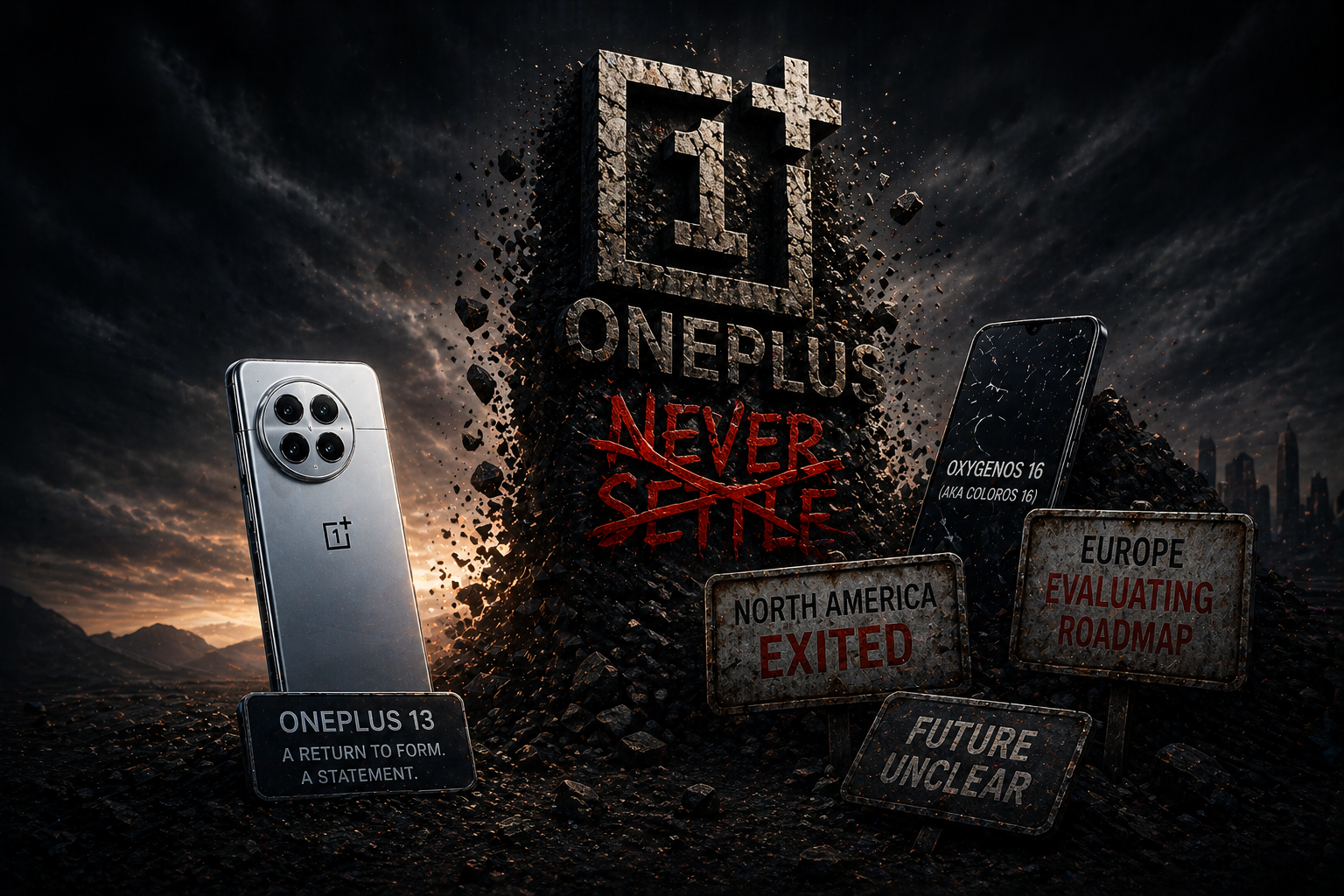
In January 2025, OnePlus launched the OnePlus 13 to near-universal acclaim. The cameras were outstanding. The battery life was unmatched in its price range. The $400 gap between it and the Galaxy S25 Ultra felt like a statement. Reviewers who had spent years watching OnePlus drift called it a return to form, a phone that finally made good on the "Never Settle" promise the brand had been coasting on without honoring for half a decade. For about six months, it looked like OnePlus had figured out how to be OnePlus again.
Then came the OnePlus 15. Then came the cancellations of the OnePlus 15s and the OnePlus Open 2. Then came the India CEO's resignation. Then came the leaked reports, the partial denials, and the Europe social media accounts going silent since mid-2025. The "Never Settle" brand is now, depending on which market you're in, either settling for managed decline or quietly disappearing altogether.
The story of how OnePlus went from Android's most compelling challenger brand to a company whose European accounts have stopped posting is not just about one phone manufacturer making bad decisions. It's about what happens when a brand built on a specific promise loses the ability to keep it, and what that reveals about the smartphone market that let it happen.
The Founder Left, and the Soul Went With Him
Carl Pei co-founded OnePlus in 2013 with a premise that was almost offensively simple: build a flagship-grade phone and sell it for significantly less than Samsung and Apple charged. No carrier deals, no bloatware, no compromise. The invite-only launch model for the OnePlus One was equal parts genuine supply constraint and masterful marketing. It worked because Pei was the human face of defiance in an industry of faceless upgrade cycles. He made buying a phone feel like a position.
Pei left in October 2020. By then, OnePlus had been deepening its integration with parent company OPPO under the BBK Electronics umbrella for years, and the tension between OnePlus's independent identity and its corporate reality had become unsustainable. His departure did not cause the decline, but it removed the one person whose instincts about what OnePlus needed to be were strong enough to resist the gravitational pull of platform consolidation.
What followed was not collapse but dilution. OxygenOS, once lean and community-tuned to a degree that made it feel genuinely different from every other Android skin, absorbed progressively heavier traces of ColorOS, OPPO's house software. By the time OxygenOS 16 shipped on the OnePlus 15, it was, functionally, ColorOS 16 with a different name. No distinct design team. No distinct camera team. No distinct software team. The shared platform made cost sense from a corporate efficiency standpoint. From a brand standpoint it was catastrophic, because the thing OnePlus fans had been paying for was the sense that someone at the company actually cared about what made OxygenOS worth using.
The Numbers Don't Lie
OnePlus shipments dropped more than 20% in 2024, falling from roughly 17 million units to somewhere between 13 and 14 million. While OnePlus was contracting, parent company OPPO grew 2.8% over the same period. That split is the clearest evidence that this is not a market problem. Samsung and Apple are not taking OnePlus's lunch. OPPO is.
India, which accounts for well over half of OnePlus's annual global shipments, tells the starkest version of the story. The brand's premium segment share in India collapsed from 21% to 6% in the 12 months through 2025, a drop so steep that IDC and Cybermedia Research both flagged it as extraordinary rather than cyclical. OnePlus's overall market share in India now sits at approximately 2.4%. The flagship-killer positioning that once made OnePlus the default recommendation for anyone who wanted an Android phone without paying Apple prices has been replaced by Vivo, Motorola, and increasingly OPPO itself.
In the US, the picture is even bleaker, for simpler reasons. No carrier has stocked a OnePlus device in years. In a market where roughly 90% of smartphone sales move through carrier retail, that is not a niche problem. It is an existential one. The North American operation, which once had a proper headquarters in Dallas, now runs out of a small Palo Alto office with fewer than 15 employees. The Dallas office closed in March 2024 without a public announcement.
What's Actually Happening at BBK
The most useful frame for understanding the current situation is not OnePlus in isolation but the broader BBK portfolio strategy. BBK Electronics owns OnePlus, OPPO, Vivo, and Realme. For years, running four distinct brands with partially overlapping positioning in overlapping markets made sense because each had genuine differentiation and relatively low overhead from shared supply chains. That calculus has changed as hardware costs have risen and mid-premium competition has intensified.
OPPO has confirmed the global release of the Find X9 Ultra, a device that competes directly in the premium flagship space OnePlus traditionally owned. With OPPO now ready to take that position globally under its own name, the strategic case for maintaining OnePlus as a separate premium presence in Western markets weakens considerably. Realme, meanwhile, is being repositioned as the online-focused budget play. The portfolio is consolidating, and OnePlus is the brand with the least distinct role in the new structure.
Leaked reports from January 2026, partially denied and never fully refuted by OnePlus, described OPPO planning to phase out the OnePlus brand globally in favor of Realme, exit North American and European markets, and pivot the India operation almost entirely to budget and mid-range Nord devices. OnePlus's response was a tweet from the India CEO, Robin Liu, saying "We're operating as usual and will continue to do so. Never Settle." Liu stepped down on March 31, 2026, his last day with the company.
Europe's OnePlus social media accounts have been largely silent since mid-2025. Multiple senior European managers posted LinkedIn farewells within the same week in April 2026. The company is officially "evaluating its regional roadmap" in Europe. That is the corporate equivalent of a disconnected phone line.
The Broader Warning
Android Authority's Robert Triggs put it plainly in a piece earlier this year, watching the OnePlus 13 and 15 side by side: HTC lost its design language and descended into irrelevance. LG's desperate portfolio left everyone confused about who it was building phones for. Both were once major players. Both denied reports of decline right up until they stopped being relevant. Identity matters, especially for brands that need to actually break through in a market Apple and Samsung have structurally dominated.
The comparison is apt, but it undersells the specific tragedy of OnePlus. HTC and LG failed because they could not keep up technically. OnePlus failed while being technically capable. The OnePlus 13 proved the hardware teams still knew how to build a great phone. The problem was not the engineers. It was that the organizational decisions surrounding the hardware, the software consolidation, the carrier relationship failures in the US, the corporate integration that stripped away everything that made the brand feel independent, dismantled the context that made the hardware matter.
Phones are not bought on specs alone, particularly in the mid-to-high price range where OnePlus competes. They are bought on brand trust, on the sense that a company has a coherent point of view about what a phone should be and has designed toward that point of view with care. When OxygenOS became indistinguishable from ColorOS, that trust evaporated regardless of what the benchmark scores said. Customers who had been fans since the OnePlus One days were not upgrading. New customers had no compelling reason to choose OnePlus over OPPO, which offered the same hardware at similar prices with more consistent retail support.
The OnePlus 16 is now rumored to be exclusive to China. If that holds, it will mark the effective end of OnePlus as a global challenger brand, whatever the company's official statements say. The name will likely survive in some form, preserved for brand equity in India and China. But the brand that once made a credible argument for why you did not have to choose between Apple quality and Apple prices will have quietly settled, one organizational decision at a time, for exactly the kind of corporate anonymity it was founded to reject.