


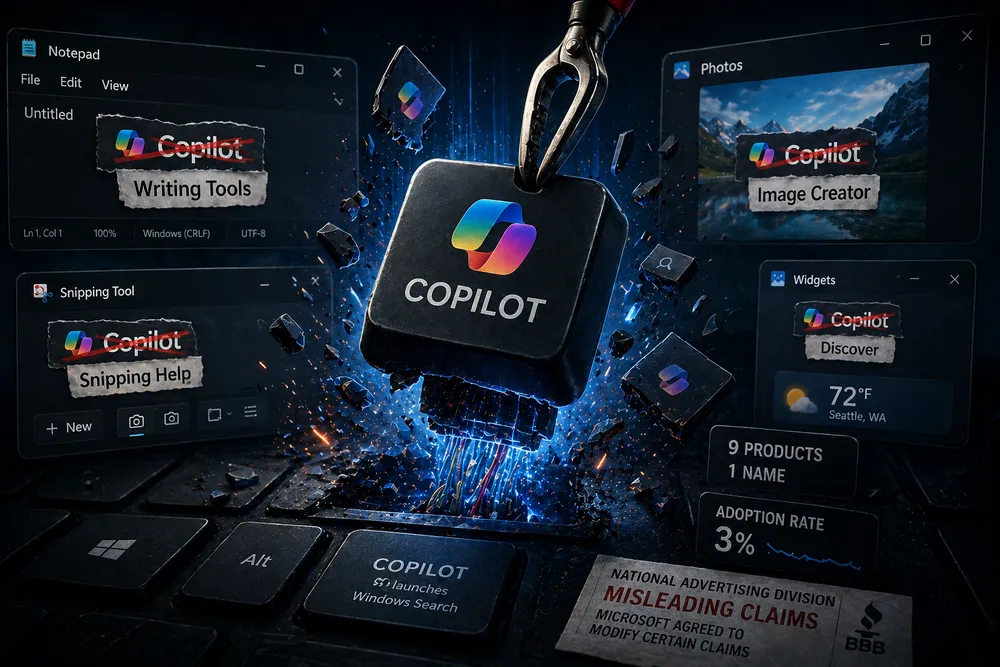


There is a moment in most branding disasters where the company stops pretending things are fine and starts quietly reversing course without admitting what happened. Microsoft reached that moment in March 2026, when it announced it was removing Copilot from Windows apps including Notepad, Snipping Tool, Photos, and Widgets. Pavan Davuluri, the Executive Vice President of Windows and Devices, framed it as becoming "more intentional" about where Copilot appears. What he was actually saying, translated from corporate: we put it everywhere, users hated it, and now we are taking it back out.
This week, that rollback became concrete. Microsoft removed all Copilot branding from Notepad, quietly renaming the AI integration "Writing Tools" while leaving the functionality identical. Same feature. Different name. No acknowledgment that anything went wrong. It is a move so characteristic of how large companies handle self-inflicted wounds that it barely warrants comment on its own. What does warrant examination is how Microsoft arrived here, how badly the Copilot branding strategy failed, and what it actually cost.
Nine Products. One Name. Zero Clarity.
At its peak, Microsoft had nine distinct products using the Copilot name. Microsoft 365 Copilot. Copilot Pro. GitHub Copilot. Copilot in Windows. Copilot for Security. Copilot for Service. Microsoft 365 Copilot Chat. Microsoft 365 Business Chat. Copilot Studio. Each had different capabilities, different pricing tiers, different data protections, and different integration points with the rest of Microsoft's ecosystem. They shared one brand and almost nothing else.
The confusion was not a perception problem. The National Advertising Division of the Better Business Bureau reviewed Microsoft's Copilot branding and advertising in June 2025 and ruled it misleading. Specifically, NAD found that Microsoft's productivity claims lacked objective support and that the limitations of its Business Chat product were not clearly disclosed. Microsoft agreed to modify certain claims. It kept the confusing product names. An admission that the advertising was misleading, followed by no meaningful change to the thing that caused the confusion: that is a company that understood the problem and decided the short-term branding value was worth more than fixing it.
The situation was bad enough internally that a Microsoft employee leaked the sentiment directly: "There is a delusion on our marketing side where literally everything has been renamed to have Copilot in it." A high-ranking Microsoft executive, separately, reportedly called most Copilot AI tools "gimmicky." These were not outside critics lobbing complaints. These were people inside the organization describing what they were watching happen.
The Adoption Numbers Tell the Story
The branding problem would be easier to dismiss if the underlying product had taken off. It did not. As of early 2026, roughly 3% of the Microsoft 365 user base had adopted Copilot, despite Microsoft investing more than $60 million in television advertising for the product in 2025 alone. GitHub Copilot, the clearest success in the portfolio with approximately 4.7 million paying subscribers, was the exception, not the pattern. In general-purpose office productivity, where Microsoft has the deepest installed base in enterprise history, Copilot simply did not convert.
A 2025 Gartner survey found that only 6% of enterprises had successfully moved generative AI projects beyond the pilot phase and into production. For IT teams trying to actually deploy Copilot, the blockers were structural: data governance issues, unclear permission models, a $30 per user per month price tag requiring documented ROI, and an interface that users in Word and Outlook described as intrusive rather than helpful. Copilot did not fail because employees were resistant to AI. It failed because the product was shoved into workflows without solving real problems, and the branding made it impossible to have a coherent conversation about what it even was.
The Copilot key on Windows keyboards, announced with significant fanfare in January 2024 as a hardware signal that AI had arrived in PC computing, quietly became a key that launches Windows Search when Copilot is not actively running. A button on 100 million keyboards that opens a search box. That is not a product failure in isolation. It is the physical manifestation of a strategy that prioritized the appearance of AI integration over the substance of it.
What Actually Happened Here
Microsoft's Copilot strategy was not primarily a branding failure. The branding failure was a symptom of a deeper miscalculation about what AI adoption in enterprise actually requires.
When Satya Nadella pivoted the entire company toward AI following the OpenAI investment, the organizational response was to Copilot-stamp everything in the portfolio simultaneously. This made sense as a stock narrative. Investors in 2023 and 2024 rewarded AI association aggressively, and Microsoft's share price reflected that. The internal logic was coherent: signal to the market that Microsoft was not a legacy productivity company but an AI infrastructure company, and use the Copilot brand as the visible thread connecting every product to that identity.
What the strategy underestimated was the difference between marketing AI and deploying it. Enterprise IT teams do not adopt tools because they carry an exciting brand. They adopt tools that solve specific workflow problems, clear the security and governance review, integrate cleanly with existing infrastructure, and justify their cost with measurable output. Copilot in its early form failed most of those tests. The branding made the failure more visible, not less, because it connected every underwhelming implementation back to a single, increasingly tarnished name.
Managing a large Windows environment, the Copilot rollout looked less like a product launch and more like a compliance problem. Features appeared inside applications that users had not requested, collecting data through mechanisms that required careful review before deployment. The governance conversations were not about whether AI was useful. They were about whether the specific implementation had been tested, contained, and documented. That is the kind of friction that does not show up in earnings calls but determines whether enterprise adoption reaches 3% or 30%.
The Rollback and What Comes Next
Microsoft's March 2026 reversal is honest in its own way. Abandoning plans to integrate Copilot into Windows notifications, Settings, and File Explorer, after announcing those integrations in 2024, is an acknowledgment that the ambient AI strategy was wrong. Reducing Copilot entry points across first-party apps is an acknowledgment that placement does not equal adoption. The community term that emerged for the over-integration, "Microslop," is less charitable but more precise.
What Microsoft has not done is simplify the product naming. As of April 2026, the nine-product Copilot taxonomy still exists, the NAD ruling is still in effect, and the primary change visible to users is that some buttons now say "Writing Tools" where they previously said "Copilot." This is the company acknowledging the symptoms while treating them as cosmetically as possible.
The more significant question for 2026 is whether Microsoft 365 Copilot, the paid enterprise tier at $30 per user per month, can build an adoption story beyond the current 3% base before the narrative around enterprise AI matures enough that "we have Copilot" stops being a differentiator. Microsoft recently launched the M365 E7 subscription tier at $99 per user per month, bundling Copilot as part of a broader agent-centered offering. That is either a bet that bundling will drive adoption the way bundling drove Office adoption in the 1990s, or it is a bet that enterprise customers will pay for the bundle without interrogating whether they are actually using the AI components. Both have historically worked for Microsoft. Neither is a product success story.
The Copilot branding era will likely be remembered as a case study in what happens when a company's investor narrative and its product reality diverge too sharply for too long. The rollback is underway. The question is whether what replaces it is genuinely better, or just more carefully named.






Comments