


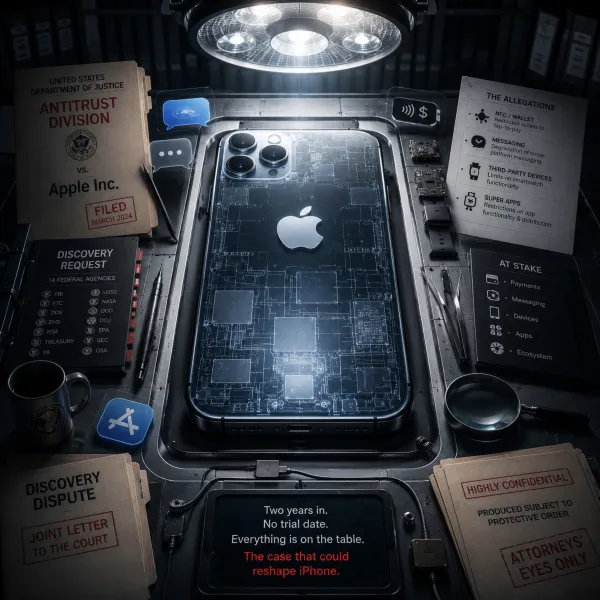


Most antitrust cases look dramatic in the filing and mundane in the middle. The Department of Justice's lawsuit against Apple, now in its third year, has arrived squarely at the mundane middle.
This week Apple and the government filed a joint discovery dispute letter with the U.S. District Court for the District of New Jersey. Apple is asking a federal judge to compel the DOJ to produce documents from 14 federal agencies that Apple argues are relevant to its defense. The government's position is that those documents are not required. Neither side is backing down. No trial date has been set. No settlement talks have been publicly acknowledged.
The coverage this generated was minimal, and that is understandable. Discovery disputes are procedural. They do not produce verdicts or injunctions or the kind of outcome that translates into a clean news headline. But the Apple DOJ case is the most consequential antitrust proceeding in the consumer technology industry right now, and the discovery phase is where the evidence that will ultimately decide it is being assembled. The mundane middle matters.
What the Case Is Actually About
The DOJ filed its antitrust complaint in March 2024, joined by 16 state and district attorneys general. The core allegation is that Apple illegally maintains a monopoly in the smartphone market by systematically restricting what third-party developers, hardware partners, and competing services can do within the iOS ecosystem.
The specific claims are more concrete than the summary makes them sound. The DOJ alleges Apple degrades the quality of cross-platform messaging, specifically the iMessage experience for non-iPhone users, as a deliberate mechanism to make switching away from iPhone socially and technically costly. It alleges Apple blocks the development of "super apps" that would reduce platform dependency. It alleges Apple limits the functionality of third-party smartwatches paired with iPhone. It alleges Apple withholds NFC chip access required for competing digital wallets to offer tap-to-pay functionality on the same terms as Apple Pay.
Apple's response to each of these is consistent: what the DOJ characterizes as anticompetitive restriction, Apple characterizes as security, privacy, and the design choices that differentiate iPhone from every competing device. Third-party wallets can access tap-to-pay through a mechanism Apple developed that protects user data. Third-party smartwatches can pair with iPhone, share data via companion apps, and access developer APIs Apple provides. The messaging experience reflects how iMessage works, not a deliberate degradation of competing protocols.
Judge Julien Neals denied Apple's motion to dismiss in June 2025, finding the DOJ's allegations sufficient to proceed. The case is now in active discovery.
Why the 14 Agencies Matter
Apple's request for documents from 14 federal agencies is not a stalling tactic, at least not obviously. It reflects Apple's core defense strategy.
The argument Apple is building is that the government uses Apple products across federal agencies precisely because the same platform restrictions the DOJ characterizes as anticompetitive are what make iPhone trustworthy for sensitive government use. If federal agencies purchase iPhones, rely on iMessage for internal communication, and depend on the closed ecosystem's security properties, Apple's lawyers argue that is evidence the restrictions serve legitimate purposes. Government adoption is Apple's character witness.
Whether that argument ultimately persuades a judge is a different matter. The DOJ's position is that the agencies' internal documents about Apple products are not relevant to whether Apple's platform practices harm competition in the consumer smartphone market. A company can be both secure enough for government use and anticompetitive in how it maintains that security. Both things can be true simultaneously.
The standoff over discovery is, in miniature, the entire case. Apple wants to show that its restrictions are justified by real-world benefits. The DOJ wants to show they are primarily mechanisms for locking users in. The documents in those 14 agencies are, in Apple's view, evidence for the former. In the government's view, they are a distraction from the latter.
What Is Actually At Stake
The practical consequences of a ruling against Apple in this case would be significant. Not immediately and not cleanly, but structurally.
If a court finds that Apple's NFC restrictions constitute anticompetitive behavior, Apple could be required to open tap-to-pay access to competing wallets on equal terms. That would not eliminate Apple Pay, but it would end the default advantage that comes from being the only option for contactless payments on a device a third of American smartphone users carry. The financial services implications are substantial.
If a court finds that Apple's messaging practices constitute deliberate competitive harm, Apple could face requirements around messaging interoperability that go further than the RCS adoption the EU already extracted through Digital Markets Act pressure. The social switching cost that keeps iPhone users in the ecosystem would diminish.
If the DOJ prevails on the super app claim, Apple could face restrictions on how it enforces App Store rules against apps that replicate core iPhone functionality. That is the scenario Apple's legal filings describe as a "dangerous precedent" for government dictating product design.
None of these outcomes are imminent. No trial date means the substantive phase of the case could be years away. Summary judgment arguments will come first, and either side could win at that stage. An appeal would follow any ruling that goes against either party.
But the case is moving. Discovery disputes like the one filed this week are how the evidentiary foundation gets built. The documents that will ultimately appear in front of a judge are being assembled right now, in the procedural maneuvering that generates no headlines and decides everything.
The Parallel That Matters
The Google antitrust ruling handed down in 2024, finding that Google illegally maintained its search monopoly through default placement agreements, is the closest recent precedent. That case took years of discovery and trial before producing a ruling. The remedy phase, determining what Google is actually required to do, is still ongoing.
The Apple case is earlier in the same arc. The allegations are structurally similar: a dominant platform company using default advantages and access restrictions to maintain market position. The legal theory is the same Sherman Act violation. The scale of potential remedies is comparable.
Google's case produced a finding of liability and an ongoing remedy fight that includes the possibility of requiring Google to divest its Chrome browser. The Apple case, if it follows a similar trajectory, could produce remedy discussions that go places neither Apple nor the DOJ has publicly contemplated yet.
That is not a prediction. It is a reason to pay attention to what looks, right now, like a slow-moving procedural dispute over document production. The discovery phase of the case that changes what an iPhone can do looks exactly like this.






Comments