

Withings Takes Your Apple Health Data for Free. Sending Your Weight Back Costs $99.99 a Year
Importing your Apple Health data into Withings is free. Sending your own measurements back now costs new users $99.99 a year.


The most revealing line on Withings' new paywall is not the price. It sits in a box labeled "Always open to you," under the heading "Import stays free," and it promises that your Apple Health data "keeps flowing into the Withings app, member or not."
Read the whole screen, which a Reddit user shared this week, and the arrangement is plain. Everything Apple Health knows about you can move into Withings for nothing. The weight your Withings scale measured and the blood pressure its cuff recorded can only travel the other way if you pay $9.99 a month or $99.99 a year.
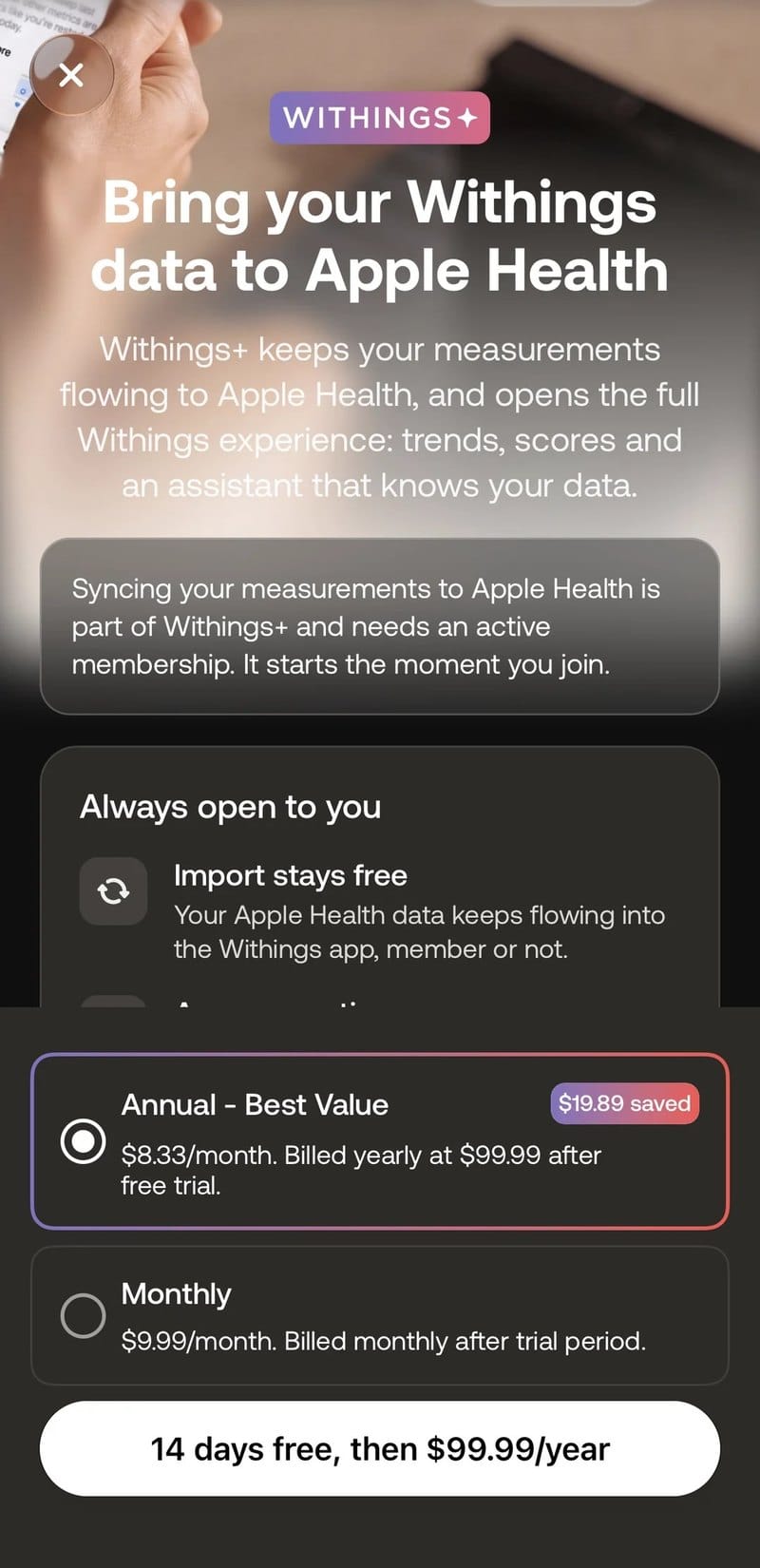
That one-way street is the whole story. Withings says subscription revenue funds clinical validation, regulatory work and the infrastructure behind its platform. A company that needed money to move data would charge in both directions. Withings charges in one, and it picked the direction that keeps you inside its app.
What changed, and who pays
For Withings accounts created from mid October on, sending measurements to Apple Health, Google's Health Connect or any app on Withings' free developer plan now requires a Withings+ membership. The exact cutoff depends on which Withings page you read: its developer site says October 12, its support article says October 13. Accounts that existed before then, in Withings' words, "will never need to worry about this change," and MacRumors reports that holds even when an existing customer buys a new device.
The developer side is the part fewer people have noticed. Withings' Partner Hub says Withings+ "becomes required on the Start for Free API plan from October 12, 2026," and that apps already live are included. A new customer who wants their weigh-ins in a nutrition tracker or a training app hits the same fee unless that app's developer pays for Withings' Enterprise plan. Apple Health is simply the most visible door Withings closed.
Even the price doesn't hold still. The App Store lists Withings+ at $9.99 a month or $99.99 a year, and the in-app paywall offers a 14-day trial. Withings' own website lists $9.95 and $99.50, with a free month when you add it at purchase. Small gaps, but for a change that rewrites what a Withings scale costs to own, buyers deserve one number.
The scale Apple is still selling
Apple sells the Withings Body Comp for $229.95 in its online store. The listing highlights that the scale is "compatible with Apple Health," the tech specs repeat it, and nothing on the page tells a new owner they will need a subscription for the scale to send anything there.
That listing shows how central Apple Health has been to the Withings pitch. In an Apple household, the reason to pay Withings prices over a cheaper scale is that your measurements land in the Health app next to everything your iPhone and Apple Watch collect, where trends, health records and your other apps can use them. Plenty of cheaper scales already send data to Apple Health with no membership. Take that away and Withings is asking a premium for hardware whose most useful connection now rents by the year.
Do the math on the Body Comp. Five years of Withings+ at the App Store price comes to $499.95, more than twice what the scale costs. No one comparing scales on a store shelf will ever see that number on the box.
Egress fees for your body
Anyone who has managed cloud infrastructure knows this model. The major cloud providers charge nothing to bring data in and bill you to take it out. Those egress fees rarely show up in the sales pitch, but they are what turns a vendor into a dependency, because leaving costs more the longer you stay. Withings has applied the same logic to a bathroom scale. Import is free because every step count flowing in makes the Withings app more central to your health. Export costs money because data flowing out is what lets you leave.
Withings' other explanation makes the decision harder to defend, not easier. French outlet Clubic reports the company tied the change to a reworked API and tighter privacy controls built for its new AI connector, which lets assistants such as ChatGPT and Claude read your health data. Clubic's response is the right one: Apple Health sync worked for years without any of that. Building an AI feature is a reason to charge for the AI feature.
And Withings+ does include things worth paying for. A cardiologist reviews your ECG within hours. There is an AI health assistant and a daily readiness score. Those are services with real costs behind them, and charging for them is fair. Withings even keeps a promise on its support page that "you always have direct access to your data," pointing members and nonmembers alike to a downloadable PDF. A PDF of your weight history is a receipt, though, and the line Withings crossed runs between paying for insight and paying a toll on your own measurements.
Garmin showed how to stay on the right side of it. When it launched Connect+ last year, it promised that everything already in Garmin Connect would stay free and built the subscription out of new extras. People still grumbled, but nobody had to pay to keep a feature they bought the watch for.
BMW already ran this experiment
In 2019, BMW started charging $80 a year for Apple CarPlay, or $300 for a 20 year plan. The logic matched what Withings is doing now. The hardware could already do it, the software belonged to Apple, and the fee sat on the bridge between the two. About five months later, BMW dropped the charge for its 2019 and 2020 models in the US and UK.
It tried again with subscription heated seats and gave up on those too. In 2023, BMW marketing chief Pieter Nota explained the company's new rule for features built into the hardware: "It's either in or out."
Withings will argue its version is gentler, and on the surface it is. BMW billed everyone, while Withings spared every existing account. That choice is also what makes it shrewd. The people who would complain loudest already have the feature, so the cost lands on buyers who haven't bought yet, and the backlash arrives as sales that never happen. It doesn't take a new customer, either, only a new account. One reader of Gadgets & Wearables said they were returning a Withings blood pressure monitor bought for new family accounts.
There is also a question Withings can't grandfather its way out of. The company is based in France, where the EU Data Act has applied since September 2025. Among its provisions, users of connected devices can ask for the data those devices generate to be shared with a third party of their choosing, free of charge to the user. Whether a sync to Apple Health falls under that rule is for regulators and lawyers to settle. It is still an uncomfortable question to leave hanging over a flagship subscription.
What to do if you're buying or already own Withings
If you already use Withings, keep your existing account and add any new devices to it rather than signing up fresh. Before setting up a family member, check whether they would need a new account of their own, because new accounts get the paywall. If you're shopping, price in $99.99 a year over the life of the device, or look at scales and blood pressure monitors that send data to Apple Health without a membership.
BMW backed down twice, each time within months, because a feature people already paid for is almost impossible to sell back to them. Withings has made that lesson harder to see by protecting the customers it already has, but the logic underneath hasn't changed. The things to watch now are whether Apple updates the store listings that still promise Apple Health compatibility, whether European regulators take an interest, and whether Withings decides the paywall is costing it more scales than it sells subscriptions. A scale that works with Apple Health is either in or out, and for every new customer, Withings has chosen out and set the price of getting back in at $99.99 a year.